


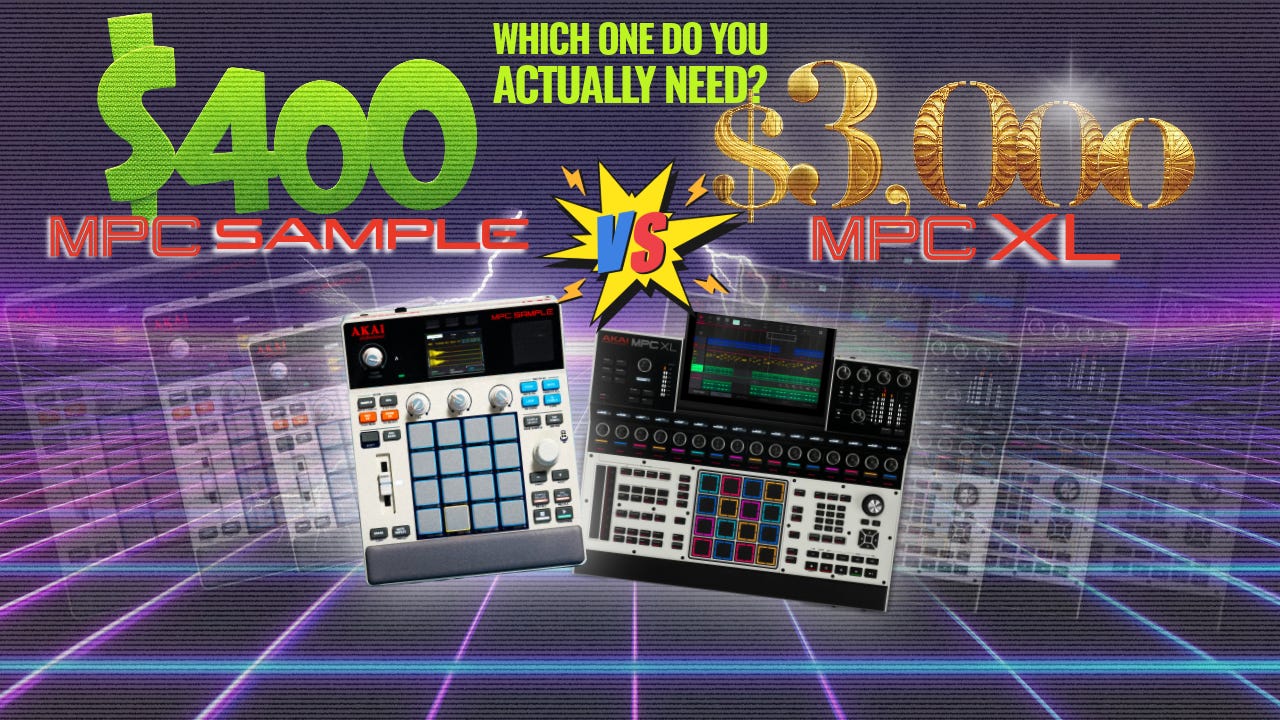
MPC Sample vs MPC XL: Which One Actually Belongs in Your Setup?
All right, what’s up, lab crew? So we’ve had the MPC sample for almost a week now. And here are our thoughts on it.
So, a few weeks back, we saw the MPC sample leak. And my immediate reaction was that a guy was creating something that would directly compete with ESP 404. I knew it, not for a fact per se, but a lot of these leaks are, honestly, more than likely driven by a Kai. But that’s just me speculating. I think it’s a great marketing strategy if that’s what they’re doing. But I didn’t feel threatened by it.
I was actually excited. I felt like, instead of the blip box, this could be an alternative standalone music production device for my 9-year-old. Personally, I’m not interested in it. I think that I am more of an MPCXL guy. I like having a richer feature set and the ability to edit individual tracks. However, I do see the advantage of this. I don’t think it necessarily replaces anything we already have in the studio. However, I do see that it can augment what you already have. But before we go into, you know, my final opinion, let’s look at what the MPC sample is and what it isn’t.
What the MPC Sample Actually Is (And Isn’t)
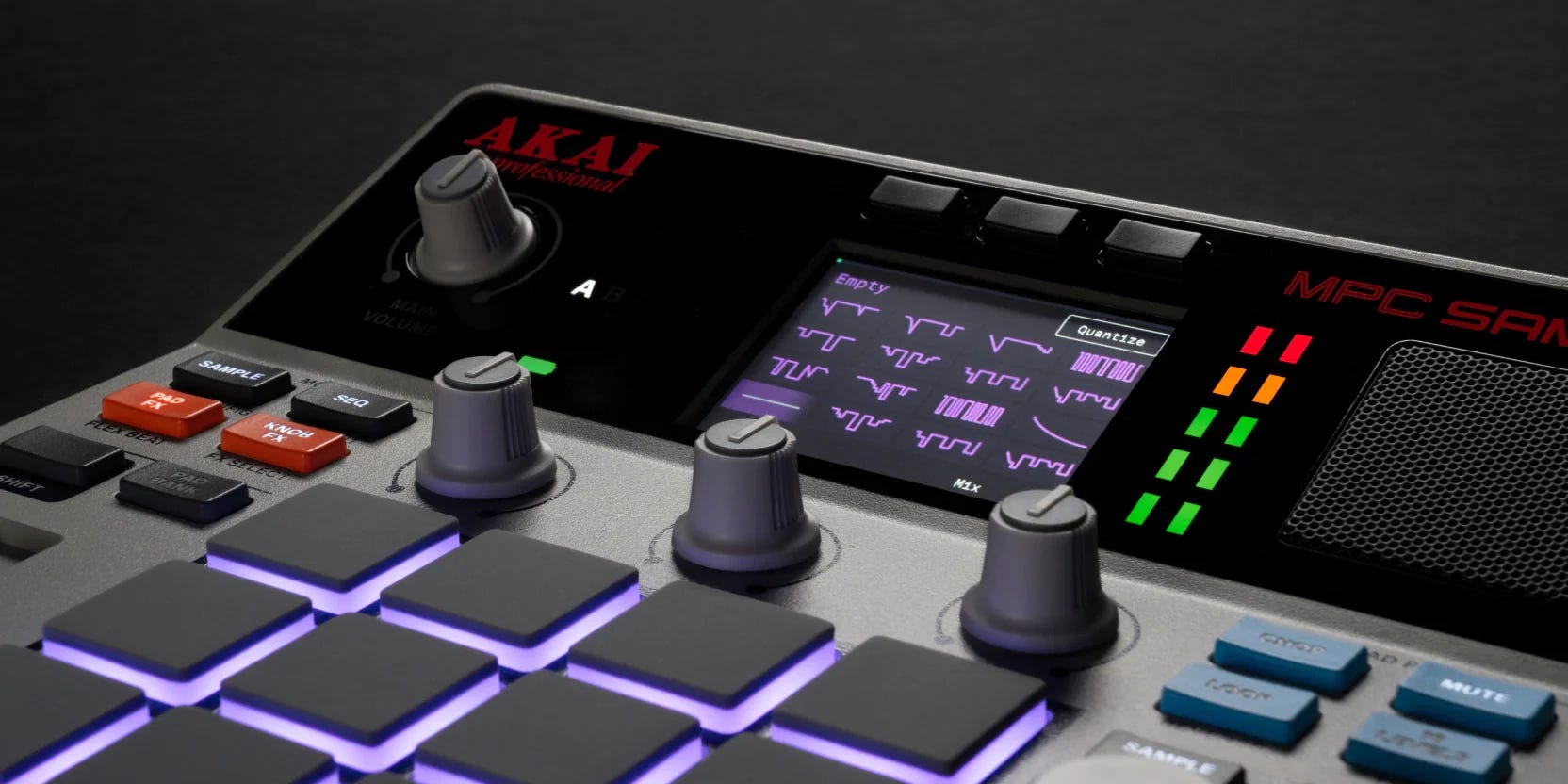
So, the MPC sample is a very compact mobile music production device that brings the fun back into music-making, keeping it simple. I think Akai has done a very good job of capturing the essence of building a musical loop, or just a musical phrase, and turning it into something complex, or enriching it with new ideas after new ideas after new ideas. The MPC sample lets you do that. You can record or load any sound you want.
Online debates often miss the purpose of the MPC sample. The MPC sample is a lower-tier offering. It’s something for a younger producer who may not have the money to invest in an MPCXL or an MPC Live Free. Somebody who wants something that’s gonna let them make music. But it doesn’t necessarily have to get in the way of the music-making process.
So, the MPC sample is something anyone can pick up and start using immediately. This isn’t for the veterans who have had every iteration of the MPC. It doesn’t mean you can’t go out and get one, but this device isn’t specifically designed for vets. This device is made for the purest, the hobbyists, the people who want to grab something and go, pretty much the same crowd as the SP 404, except not just to run samples through the vinyl emulation, right? This is definitely a beginner machine.
And honestly, I think it is a companion machine, probably something entirely different. There is a small part of this machine that I think people are completely overlooking, which I will get to later. But I think that this machine is something that you can use by itself if it’s your 1st time music production, or you could use it alongside an MPC to get ideas out when you’re hanging out with the kids on the couch or watching shows with your lady, and then take them and turn them into full-fledged songs later when you have the time.
And then I think it is something you can look at as a completely different way of making music today in 2026 that will still be relevant. I think if you want to look in that direction, DB Asi and his cola sampler are a great example of how you can make amazing-sounding music with very simple tools.
So what AKai says is it’s a sketch pad. And I kind of agree. I think it is a place where the existing MPC and a Kai Forge, MPC live, where 3 users can sketch out ideas, then go back to their larger machine to figure them out fully. And even for someone who hasn’t experienced the MPC ecosystem before. It’s a good idea just to be able to create something that isn’t generated by a machine. This is something you can sketch with a pencil and a piece of paper, rather than prompting something pretty cool. So I definitely agree that this is a sketch pad.
Where the MPC XL Still Wins
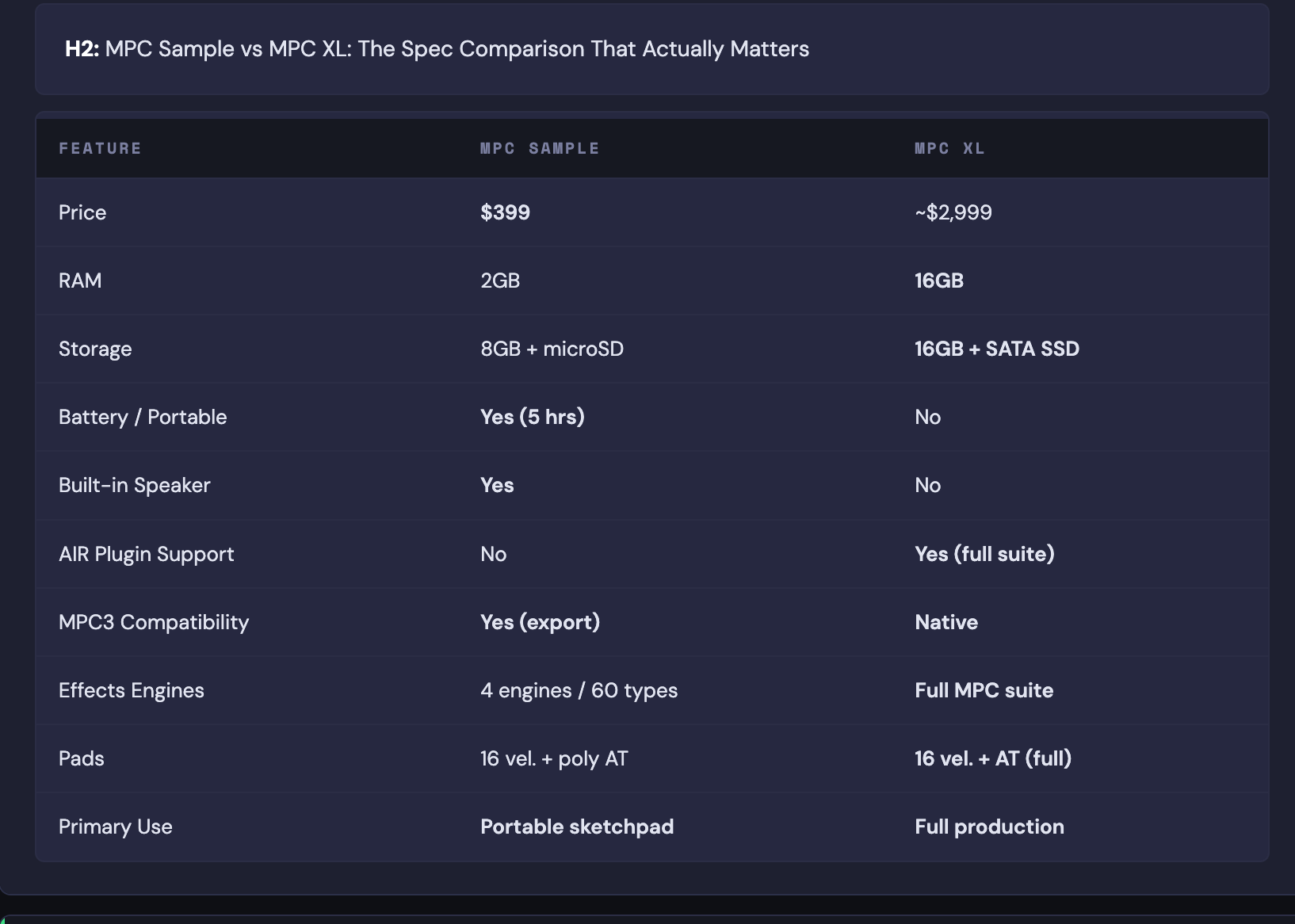
The MPCXL wins on features like track management and channel strips, which aren’t possible on the MPC sample. I like the filters as quick, but just off of compression and channel strip, and the number of tracks, it’s, it’s, it’s hands down. You beat it. It beats it on the RAM for your work on my particular workflow.
I use multiple instruments, and sometimes I bounce them down, or I’ll record into multiple audio tracks, whereas the MPC sample is very cut-and-dry: you have one track, everything’s on that track. Now, eventually, you can take it into the DAW and break it down into its individual components. But when you’re working on the MPC sample, you’re strictly creating, you’re strictly sketching, versus being on the MPC, you can sketch and fully develop your ideas and go from pre-production to post-production and completely finalize the track.
The XL can do more: control other instruments, route signals, and support plugins. The MPC sample can’t. You don’t have any channel strips. And I live by my air channel strip. So it would be impossible for me to rely on this completely.
So, for those of you who say the MPC sample is unnecessary. You’re right. I mean, if you’re looking at it from that critical aspect, where your current MPC wins, yeah, absolutely, you don’t need it.
Where the MPC Sample Has the XL Beat
Now, in areas where the sample wins are, I believe, where all of us find challenges, you know, for us MPC heads, most of us are growing. Most of us have families or responsibilities beyond just making music. And the MPC sample excels at making music and turning ideas you may have on the fly into songs really quickly. Let’s say, for example, you’re humming a melody in your head. You can actually record that through the microphone, quickly on the MPC sample, lay some drums down, and then later turn it into a fully fledged song.
Now, there’s been plenty of times when we’ve had to pull out our phones. Now, granted, the MPC sample isn’t small enough to just fit in your pocket. However, it is small enough that if you were somewhere and had a small bag, you could take her travel bag with you. You could pull the Sample out, get some ideas down, and turn those ideas into songs relatively quickly without disrupting much of what’s happening in your current scenario.
So depending on what you have going on, you know, your life, I know for me, sometimes I’m hanging out with my lady or watching my kids. I am away from my music gear, and I may have ideas that end up in voice memos that I have to come back to and then turn into something, rather than being able to do it right there in the moment and then finish that idea later. So, in a very practical sense, having the built-in microphone, speaker, and sequencing capabilities is definitely a game-changer and one of the benefits the Sample has over the MPCXL.
And when it comes to price, to be able to do that for 400 bucks is exceptional. If someone came to me and said, “ Hey, man, I have 500 bucks, and I’m looking at buying my 1st hardware machine, what should I get, you know, and they gave me between the,, teenage, engineering, TB -KO 33, or the,, The Roland 404. I’d say the MPC sample. If possible, I’d suggest saving for the XL or Akai Force. But for those on a budget who want to learn and maybe earn money, start with this: learn the MPC system, get familiar with hardware, and then move to a more advanced system. So I think $399 is a fair price for what you get. Akai is pretty much hitting the sweet spot.
Akai MPC Sample vs Roland SP-404MK2 vs TE EP-133 KO II: Which Portable Sampler Wins in 2026?

MPC Sample: Teenage Engineering Beware
Here’s My Honest Take on Akai’s Strategy
Now, here’s my take on this. Akai has released many products recently. I don’t think that they’re necessarily cannibalizing their own lineup with the MPC sample. However, I do think a Kai might end up vibe-coding their way into a situation where they’re feeding too many segments of their customer base. I think what ends up happening in that scenario is that you have a company making so many different products that there’s 0 continuity between them. And that is a major weakness that a Kai is going to have to figure out before they start bringing so many people into the ecosystem who are going to want, have so many demands, and a Kai is not in a position to solve them.
And vibe coding that might end up requiring you to completely change the entire product lineup, which you’re going to piss off customers who just spent $400 and now have to spend another $ 400. They may not be in that position yet. So you’ve got to be careful in bringing those customers in because those customers. At the same time, they are great for business, and they do look like angels initially, but they can ultimately become little tiny devils in your business if you don’t have all your ducks in a row. And as someone who’s a major Akai fan, Akai does not have its ducks in a row, especially when you have something this capable at 399.
The XL, costing almost 3 grand via aKai foForcean, completely blows both of those things out of the water, right in the middle, as a completely different offering. and a seven-year-old offering at that. I think aKai has some offerings that are all over the place and don’t necessarily fit their current value ladder. And to mention products like the MPK series or the Akai Advanced series keyboards that are not 100% compatible in terms of features, feature integration with either the MPC or the Akai Force. So, a kind needs to integrate their products better because their customers will be looking for ways to augment their current setups. And if they don’t have that ability to use the features currently on all Akai products, Akai customers are going to be frustrated with their purchases because they’re going to have $300, $400 bricks sitting at home, like me.
3 Things People Are Getting Wrong About the MPC Sample
“It’s just a thingy”.
- With 60 effect types, poly aftertouch, and full MPC3 project export, this is not a toy. It’s a focused tool with professional-grade bones that happens to fit in a backpack.
“It replaces the MPC XL for most producers.”
— The absence of plugin support, 16 GB RAM, and the full MPC OS make the XL irreplaceable for anyone finishing records. The Sample was never meant to go that far.
“The MPC Sample is only for beginners.s”
— Akai designed this as a companion device for working producers who need a portable capture tool. The field-to-studio pipeline it enables is a pro move, not a beginner crutch.
How I’d Use Both Together
All right. So, here’s how I’d use both of these together.
Let’s say I get the MPC sample and want to make a track with my daughter. Well, of course, I want to load up some of my favorite drum sounds, but I also want her to pick some. So we can either go to BandLab or find some good, legal, free drum wherever. And then, of course, start making an idea.
Nah, of course, now she’s going to have bedtime, and I have daddy time, so I can take that track that we both made. And then completely augment that with my new instruments, or my full instruments, on the XL or the Force. And so I think one of the 1st things you do when you open the sample project in Excel is try to split each of those sounds into its own track, which I don’t know how it’s going to work yet. I have not seen anyone convert a sample track to an XL track. So if you have that, please drop the link in the comments, because I haven’t seen anyone who’s done that.
I think that this is a fully capable device. I think that even in that scenario, if we make a reasonable track, I think that it’s totally plausible that you can take whatever you make on the MPC sample and turn that into a full track. I think we’re in the days now where if the music sounds good, it sounds good. We’re outside of the loudness wars. We are in the streaming wars, we are in the attention wars, and you’re in a place now where your music can be heard, no matter who your audience is. So you don’t necessarily have to spend all the time mixing everything down. If you’ve made something in the Sample that sounds amazing and you want to run with it, I think you can run with it 1000%.
The Bottom Line
Buy the MPC Sample if you need a portable idea-capture tool, you’re just starting, or you want a dedicated sketchpad that lives in your bag.
Keep your MPC XL if you’re finishing records, using plugins, or need the full MPC OS for complex project management.
Use both if you want a field-to-studio pipeline where the Sample feeds ideas into the XL — this is the power move.
Frequently Asked Questions
Is the MPC Sample a replacement for the MPC XL?
No. The MPC Sample is designed as a portable entry point and companion device, not a replacement. The XL offers significantly more RAM, plugin support, and the complete MPC OS capabilities that the Sample intentionally omits to keep its portable workflow focused.
Can the MPC Sample work with AIR Musplugins plugins?
Not directly. The Sample runs a streamlined engine focused on sampling and built-in effects. You can export projects to the MPC3 software, where plugins are fully accessible within the desktop workflow.
What’s the price difference between the MPC Sample and the MPC XL?
The MPC Sample retails for $399; the MPC XL retails around $2,999 — a difference of approximately $2,600. For producers on a budget, the Sample offers significant value as a starting point or field companion.
Does the MPC Sample support microSD cards?
Yes. The Sample ships with 8 GB internal storage and a microSD slot for expanded storage of samples, projects, and audio files.
Can I move a project from MPC Sample to MPC XL?
Yes. Projects created on the Sample are compatible with MPC3 software, which can then be continued within the MPC XL ecosystem — making it a practical bridge between field and studio workflows.
How does the MPC Sample compare to the Roland SP-404 MK2?
Both are portable samplers in a similar price range, but they target different workflows. The SP-404 MK2 leans into performance and lo-fi aesthetics; the MPC Sample prioritizes the MPC sequencer workflow and full AKAI ecosystem compatibility.
All right. So, here’s my final take on this. Is the MPC Sample the best portable sampler in 2028? Is this a ‘worth it’ addition to your DAW-less beatmaking setup?
well
If you’re sitting between, “am I gonna buy something affordable?” or “am I gonna go all in? What do I do?”
I recommend you ask yourself a realistic question. Are you going to earn money from this, or is this going to be a hobby for you? And you have to be realistic: when you say, ‘are you going to earn money,’ or ‘can you do everything you need to do to be successful in your endeavor,’ or is this a passion project for you, and are you looking to have more fun? If you’re looking to have fun, get the MPC sample. You’re going to have a lot of fun, and you can justify spending $400. If you’re looking to make money, get the MPC Excel. It’s something that’s going to Force you to do what you need to do to recoup your investment in your music.
Otherwise, I would say that there are 2 very capable devices that you can have a lot of fun making music on. And my question for you is: are you more of a hobbyist, or are you pursuing your passion while also trying to be compensated? I want to know. I want to know where my audience lies.
I think I’m going to get the MPC sample. I’m going to get it for my daughter. I think it’s a really cool device. How about you? Let’s talk about it in the comments. Peace.
💬 Got a take on MPC Sample vs your current setup? Drop it in the comments.
My Triton has 96mb of sample memory and does all that beat chopping fun stuff that an MPC can do and you get those on ebay for cheap. But damn, if I had Elon money an MPC XL is a good replacement for a DAW.