


Get Honest Mix Feedback Without Paying for Mastering
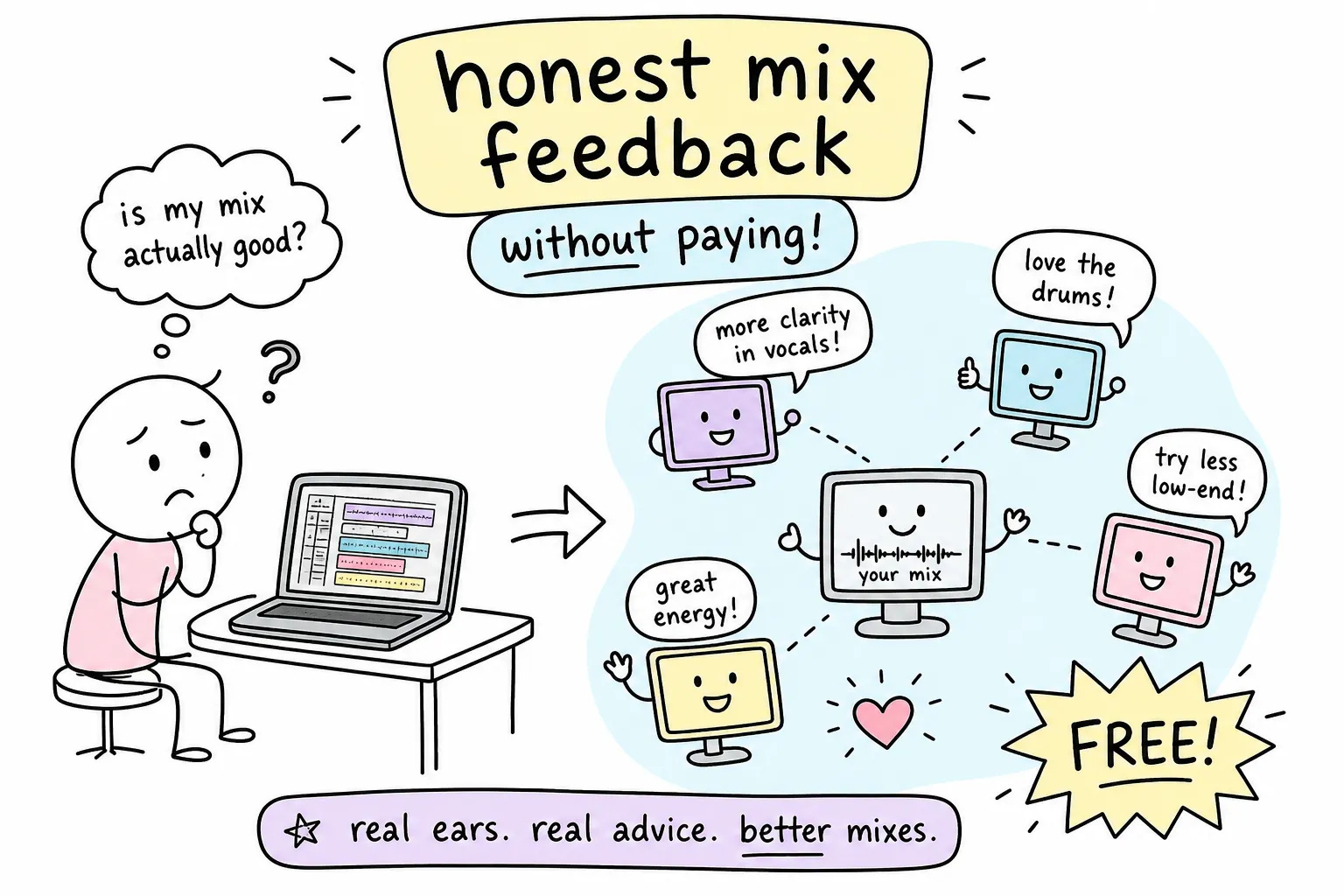
Here’s a question everyone asks but is too afraid to look dumb: “Where can I actually get good mix feedback without dropping $40 on a stream submission just to play 10 seconds and get no true feedback?”
You know how it goes: you join a stream, post your track, get some shitty feedback, so you resort to posting in some random Facebook group, waiting a few days, and all you get are a few fire emojis and a “this slaps”. While that's some feedback, it's not REAL feedback; it's really people being nice online and supporting their community. It doesn’t help you fix low-end issues or figure out why your vocals keep disappearing in certain parts. The real issue isn't finding the right community online to post your mix; it'sfinding someone you can trust who actually knows what they are talking about and will give you good, useful feedback.
The question I’ve heard come up in discussions over and over is: to get real feedback, is it better to pay for mastering?
Mastering engineers are listening for different things than at the mix stage. While they are still listening to the technical aspects of the song, they are also factoring in the production and how the unresolved low end is pushing the feeling away from the vocalist. Or the snare is swallowed up by your pads.
While this inclination MAY be real, it’s really the wrong service in the wrong order.
Mastering is for enhancing a mix that is already working, not for fixing a mix. That is a critical waste of a mastering engineer’s time, and most will not put their reputation on the line for the sake of you learning how to mix.
So here's what we’re going to break down today.
Where you can actually get real feedback, for free.
What paid services are worth it, and how to prepare your mix in a way that gets you real advice, real feedback instead of ‘sounds good bro’ or a rating of 1-10.
By the end of this, you should know exactly where to drop your next mix and what to include so you actually get some useful feedback you can learn from and maximize your next efforts.
TLDR:
“Don’t pay for mastering for mix feedback; mastering engineers polish finished mixes, not fix muddy low end or disappearing vocals. Use vetted places like The Practical Audio Lab, Reddit’s r/mixingmastering, genre Discords (Jonas Aden’s for EDM), or low-cost services such as MixReflect, and submit high-quality files plus specific problems to get actionable, technical critiques.”
Where to get professional mix feedback without paying for mastering
Not every streamer is created equal; some of these guys are your average person who releases music and has a following.
And some of these groups are just a bunch of beginners with expensive equipment tossing around surface-level takes because they lack the vocabulary to critique what they are hearing. BUT there are a few places where these indie opinions can be helpful. MOST of the time, this is about authenticity: you’ll know if your colorbass is not ‘colorbassin’ or if your hip hop track sounds like a Dos Equis backing track. Other than that, you’ll need more structure to get more serious feedback.
BUT
Reddit’s r/mixingmastering: the most consistent free mix review online
They’ve actually got a feedback guide in their wiki that tells you how to post. This helps a lot. In this group, you’ll find real engineers and advanced producers dropping legit technical feedback IF you provide enough actually to work with.
The trick in this group is to upload something high quality, specify the genre, and tell them exactly what’s bothering you.
If you post ‘thoughts’ you’ll get some pretty useless replies, but saying something like “ I can’t get the click to punch through the low end without everything getting muddy or clipping around 80 Hz,” you’ll get some pretty detailed, helpful responses.

Stop paying rent on your own music.
Most distributors charge you every single year to keep your existing catalog online. If you stop paying, your music gets taken down.
LANDR lets you release your tracks and know they’re up for good. Plus, you get AI mastering, plugin access, and seamless distribution all under one roof.
👉 [Keep your music online forever with LANDR — Get 20% Off]
Use Code Below for 20% Off
[Any Mastering Plugin or Subscription]
Discord servers for genre-specific feedback
The r/mixingmastering Discord has a channel just for mix critiques, and honestly, the feedback there is usually better than most places.
Their Discord has more technical takes and genre-specific stuff.
Jonas Aden’s server is also good, but quality depends on who’s online (like most discords). Discord is always great for quick feedback, especially in EDM servers like Jonas.
Facebook groups are really hit or miss. I’d say they’re worth bookmarking if you’re in the right group. Groups like Airwindows Audiophiles or All Up In The Mix (Jake Richter) have a lot of active people and sometimes do events where you can get some decent feedback. The Studio One (Fender One) community even does a monthly live mix critique. These are always good back-pocket options to keep in mind, especially for checking stuff you’ve had on repeat for a while.
Paid single-track feedback services worth your money
When you need something more structured than just random forum replies, paid services are that middle ground between free feedback and hiring someone to mix your whole track. Prices are all over the place—from under $10 to a few hundred bucks—and you pretty much get what you pay for.xReflect charges $6.95 to unlock a full written report with a release verdict. It uses a combination of AI analysis and human verification, which makes it a low-risk entry point for producers who’ve never paid for mix feedback before. SNIP offers a free first session, worth taking before you commit to anything. Their paid tiers start around $30 for a written report with timestamped feedback. Both services give you a clear picture of what structured mix engineer feedback actually looks like without a significant financial commitment.
Mid-tier services with written reports and real guarantees
Drum Collective is about $25 for a written critique, and they actually give you a 30-day money-back guarantee, which is rare and shows they back up their work. Mixing Lessons is $67 for a detailed report, but they only take two mixes a month, so you might have to wait. If you want actually to talk to someone, WKND Audio Berlin does a 30-minute Google Meet for about $54, and that’s usually where you get the most specific, back-and-forth feedback on your actual session choices.
Where The Practical Audio Lab’s mix feedback fits in
The Practical Audio Lab offers direct mix feedback from a working producer. With The Practical Audio Lab, you’re getting feedback straight from a working producer. William Butler listens to your mix like he’s deciding if it’s ready to drop—checking if the low end hits, if everything sits right, and if it sounds good on cheap speakers. You get real, honest notes, no upsell, no generic checklist. It’s just producer-to-producer feedback, perfect for indie beatmakers who want someone legit to listen and give it to them straight, without breaking the bank. What you receive is directly tied to how you submit. Most producers get vague critiques because they upload MP3s with no context and ask open-ended questions. Fix your submission habits before you send anything, and you’ll immediately start getting more useful responses.
WAV over MP3: why format actually matters for critique
If you want real feedback, give the engineer something they can actually hear. MP3s mess up the high end, and the low end—exactly the stuff pros listen for first. Always send a 24-bit WAV at 44.1kHz or better. If you’ve got a version with mix bus processing and one without, send both and label them so nobody has to guess which one is your real mix.


Reference tracks and the right context to include
Always include a commercial reference track from your specified genre when you send your mix. It gives the engineer something to compare your low end, stereo width, and transients to—basically, a real-world target. If you can, send a WAV or AIFF of the reference, but a good MP3 is fine if that’s all you’ve got. Also, add a quick note with the version number, genre, and a couple specific questions you want answered. That way, whoever’s listening knows exactly what you’re shooting for and can give you feedback that actually helps.
Specific questions get specific answers.s
If you ask, “What do you think?” you’re gonna get nothing useful. But if you say, “The low-mids feel congested around 300 or 500Hz in the second verse—does it sound that way to you?” you’ll get real answers. Point out what you think is off and ask about it straight up. Engineers respect it when you’ve already tried to diagnose the problem yourself, because it shows you’re serious about fixing it, not just fishing for compliments.
Privacy and IP: what to know before uploading stems
Sending your full mix to a private paid service is way less risky than dropping stems in a public forum, especially if your track isn’t out yet. Just know the difference and be smart about what you share.

Metadata exposure and how to reduce it
Audio files can have hidden info like your name, DAW version, and session details baked in. Before you share anything in public, strip that metadata out. The best way is to use FFmpeg with the-map_metadata -1flag. That wipes all the metadata without messing up your audio. If you’re sharing an unreleased track in a public spot, use a watermarked snippet or a password-protected link instead of just posting raw stems with your name hidden in the file info.
Platform terms and AI scanning risks
Some platforms have sketchy terms that let them use your uploads for machine learning. Always check the policy before you upload anything that isn’t released yet. For forums, it’s usually safer to share a full mix than stems, since stems can be picked apart and reused. If you really need feedback on stems, stick to private services with clear rules instead of public groups.Based on your situation
There’s no one-size-fits-all answer here. What’s best depends on your deadline, your budget, how deep you want the feedback, and if your track is already out. Think about all that before you post,t and you’ll save yourself a lot of headaches.
Tradeoffs: speed, credibility, depth, and cost
Free groups are quick, but the quality is all over the place. Paid feedback can run anywhere from $7 to $300, and turnaround can be a day or two or up to two weeks. If you’re in a rush and don’t want to spend much, try SNIP’s free session or Drum Collective’s guaranteed report. If you want something in between a random forum post and a full-on engineer session, The Practical Audio Lab gives you feedback from someone who actually makes beats, not just mixes them.
Build a feedback loop, not a one-time submission.
One round of feedback isn’t gonna fix your mix. Send it to one or two solid sources, make the changes, then send the new version back. Keep track of what you changed each time. Doing this will level up your ears way faster than any course, because you’re actually connecting your decisions to real results in your music. The goal isn’t to get it perfect on the first try—it’s to keep tweaking until the mix is really done.
Free places to get professional mix feedback, and when to pay
You can definitely get pro mix feedback without paying for mastering if you know where to look and how to send your stuff. Start with r/mixingmastering for free, consistent reviews. Try SNIP’s free session or Drum Collective’s guaranteed report if you want to pay a little. And every time you submit, send a 24-bit WAV, a reference track, and a couple specific questions. That combo will make your feedback way more useful.
If you want feedback from a producer who’s actually in the trenches If you want feedback from someone who’s actually in the trenches—not just some faceless service or another producer guessing—The Practical Audio Lab is made for you. No mastering upsell, no nonsense, just real notes on what’s working and what needs fixing from someone who’s actually doing this every day. Subscribe to The Practical Audio Lab to get that content directly in your inbox, concrete, no-filler guidance for independent producers who are serious about the work.
F.A.Q.
Q: What’s the difference between mastering and getting mix feedback?
A: Mastering engineers listen for different things than you need at the mix stage: they enhance a mix that already works rather than rebuild it. If your low end is muddy or your snare is being swallowed, sending it to a mastering engineer is the wrong service and order. Fix mix problems first, then send a balanced mix for mastering.
Q: Where can I get free, professional mix feedback online?
A: Reddit’s r/mixingmastering is the most consistent free option and includes a wiki guide that sets posting expectations. You can also use the r/mixingmastering and r/audioengineering Discord servers, plus genre-specific Discords like Jonas Aden’s and Facebook groups such as “All Up In The Mix” run by Jake Richter. Supplement with community events like the PreSonus Studio One monthly mix critique show.
Q: How should I post my mix to get actionable critiques instead of vague praise?
A: Post an uncompressed or high-quality file, state the genre, and describe the specific problem you’re hearing. Specific prompts (e.g., “I can’t get the kick to punch through without the bass getting muddy around 80Hz”) generate targeted, diagnostic responses, while vague open-ended posts attract short, non-actionable replies.
Q: Are Discord servers a good place for mix critiques?
A: Discord often delivers faster responses, but the depth and consistency vary more than a well-moderated subreddit. The r/mixingmastering Discord has a higher signal-to-noise ratio, and r/audioengineering is good for technical feedback, while genre-specific servers depend on activity and expertise at the time you post. Use Discord for quick checks and subreddits for more consistent, detailed critique.
Q: When is it worth paying for single-track feedback and which services are budget-friendly?
A: Paid single-track services bridge free peer review and full mixing gigs when you need structured, reliable critique. Prices range from under $10 to several hundred, and budget-friendly options like MixReflect charge $6.95 for a full written report with a release verdict using AI analysis plus human verification. Choose paid feedback when you want a documented, actionable report rather than ad-hoc forum replies.
Q: How do I find communities where people actually understand what they’re listening to?
A: Look for communities with structure and moderation that filter for seriousness—subreddits with posting guides, servers with dedicated critique channels, and groups that run scheduled critique events. The Practical Audio Lab and moderated spaces like r/mixingmastering or PreSonus Studio One’s monthly show tend to surface more experienced engineers and focused feedback. Avoid places where responses are mostly emojis or surface-level impressions.

