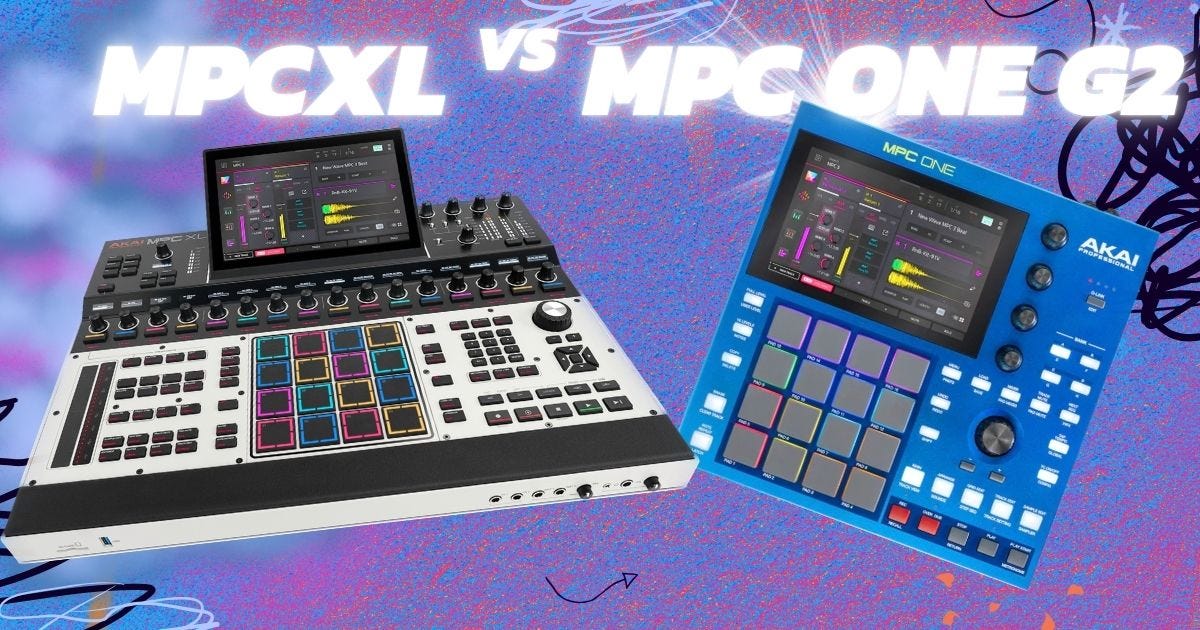

MPCXL vs. MPC One G2: Which Akai Powerhouse Is Right for You in 2026?
What’s up, PAL,
Standalone production in 2026 is no longer about whether or not you’re using a computer or what the converters sound like. It’s about how efficiently your hardware setup can handle the processing power of modern plugins, massive sample libraries, and users who aim to break boundaries. AKAI Professional has essentially dominated the market but also cornered producers with a massive logistical fork in the road.
On one side, you’ve got the towering Akai MPCXL, a zero-compromise studio centerpiece designed for full studio integration. And on the other, the MPC One G2, a streamlined compact version that contains the ‘essence’ of the MPC, designed to deliver massive processing without taking up the entire desk.
If you’re upgrading your setup or just hopping into the Akai MPC ecosystem this year, choosing between them isn’t just about price; it’s not about ‘sound ’; it’s 100% about workflow, your connectivity needs, and how you plan to leverage standalone virtual instruments and sampling into your workflow. Let's break down the realities of both machines without the marketing hype.


Which Is Better, The MPCXL or The MPC One G2?
MPCXL is best for commercial studios and power users requiring physical I/O, full console-style control over every feature, extensive storage, and more tactile control. The MPC One G2 is the superior option for producers seeking the same processing power with added portability in a desk-friendly footprint.
The Core Architectural Divide:
Spec Sheet Breakdown
Each Device is categorized based on: Form Factor, Pad Performance, Q-links, Display Real Estate, Audio Inputs, Audio Outputs, Digital Connectivity, Internal Storage
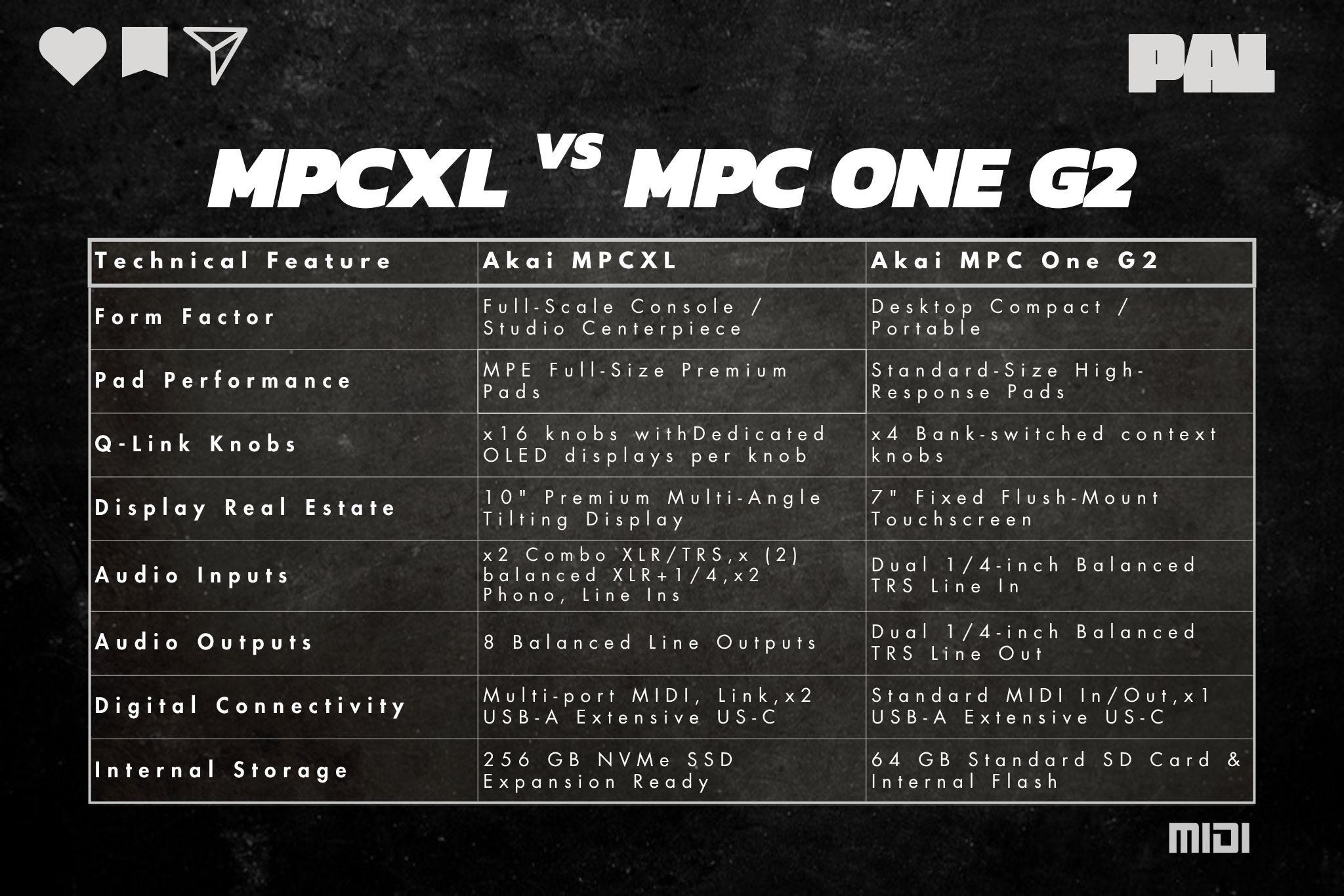
Let's start with MPCXL :
Full-scale console-size control surface - every feature has a dedicated button on the panel
MPE full-sized pads - extended directional expressive support
16 dedicated Q-Link knobs with a dedicated OLED display per knob
10” Multi-angle display with tilt
8 outputs/ 6 inputs with x2 Combo XLR/TRS
Multi-port MIDI, x2 USB-A, USB-C
256 GB NVMe SSD
Now the MPC One G2 :
Compact desktop form
Standard-size pads
x4 knobs and context-based bank switching
7”j fixed flush-mount touchscreen
Dual 1/4” Balanced TRS line-in and out
Standard MIDI I/O x1 USB-A, USB-C
64 BG Standard SD Card
Physical Feel, Presence & Ergonomics
The MPC Feel is not just about the swing and the timing, but also about how the device feels in your hands. how does it fit in the studio?
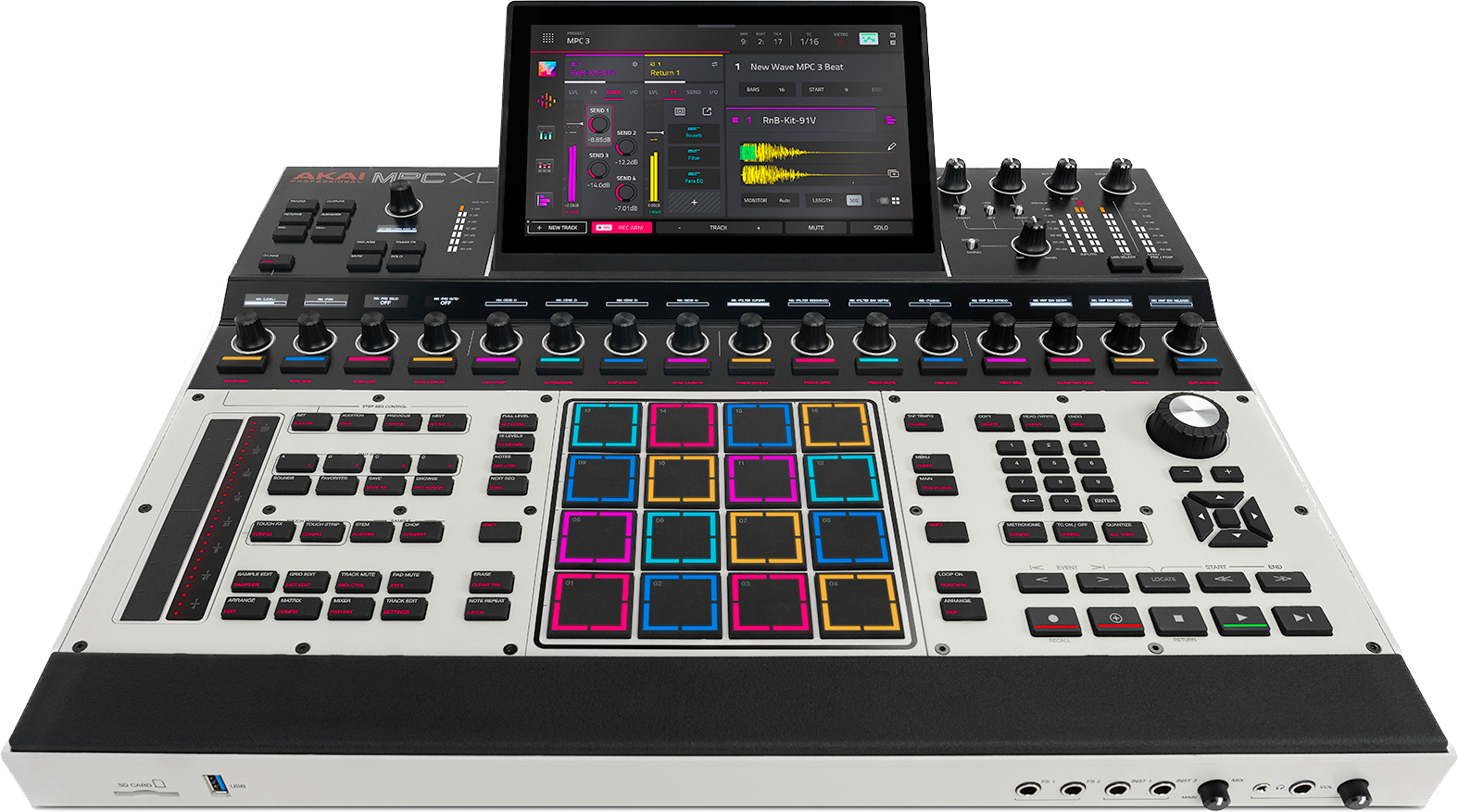
The biggest difference immediately is scale. When standing in front of the two units, the MPCXL makes a statement. It's an unyielding design, anchored right at your production desk. The sheer number of controls and the space between them mean your hands can (and have to) float around a bit.
The Power of Dedicated Q-Links
One of the main selling points, personally, is the dedicated Q-links. On the MPCXL, the array of Q-Link knobs also has a dedicated miniature OLED screen. With this deep integration, you can eliminate guessing what is being changed and focus more on the sound and less on the screen.
Compact Efficiency
The MPC One G2 approaches ergonomics from a classical standpoint. High density/compact power. It condenses the MPC workflow into a square chassis that fits easily into a backpack or duffle bag. For that semi-portability, you lose the full OLED and Q-link feature set, IMHO a somewhat steep tradeoff given their functionality. Either way, the smaller footprint is an asset rather than a compromise in smaller setups.
Standalone Plugin management and System Processing
A common point of confusion/contention is whether the higher price tag comes with a boost in boot time or improved instrument performance. Akai uses a unified processing architecture across most of the AkaiPro standalone samplers. This means the CPU and rendering capability, plugin compatibility, and RAM efficiency are pretty closely matched.
SO whether you’re loading a bunch of AIR Fabric XL instances, running modern Synths through audio tracks, or controlling via MIDI/CV, the underlying DSP is stable across all generations of MPC
The real difference is how you interact with the software, i.e., workflow.
The Screen Experience: The MPC XL has a tilting display that allows for ergonomic performance whether seated or standing; it also helps eliminate studio glare. The MPC ONE G2 has a fixed screen, meaning the device or YOU need to be positioned correctly to get the proper angle.
Data Streaming: The MPC XL architecture supports more robust storage expansion, which opens the door to stream multi-gigabyte libraries seamlessly
Button Layout: The MPC XL has virtually every feature mapped to the control surface, acting more as a highly advanced DAW controller.
Studio Integration and Connection
The choice of machine is everything when selecting gear; how your machine integrates with and connects to your existing setup affects how you sample incoming audio and which devices you may consider getting due to their limitations/capabilities. SO if you’re building a setup centered around extensive hardware and outboard gear, turntables, and patchbays, the MPCXL has the back panel to handle nearly everything from yesteryear and the future.
However , if you rely on internal sampling, digital file transfers , and a more streamlined compact environment, then you may not need the XL. It boils down to whether your machine needs to act as the master switch for a room full of synths or just function as the ultra-focused production station.
💡 Quick Reality Check: Don't let marketing hype convince you that the bigger box automatically means better music. The sonic output, the internal resolution, plugins, effects, and processing are uniform across the entire Akai Ecosystem.
I/O and Studio Connectivity Comprehensive Analysis
This is where things become black and white (excluding budget); your studio’s needs and capabilities will directly shape your purchase decision
MPCXL Connectivity Suite
If you’re using outboard hardware compression, summing mixers, analog synthesizers, standalone workstations, or modular effects units, the MPCXL is unmatched.
True Discrete Mic Preamps: Dual Combo XLR/TRS inputs with phantom power provide the flexibility to record vocalists, acoustic instruments, and room mics directly into the sampler without an additional preamp.
Eight Analog Outputs: One of the core features of tracking out on the MPC is routing individual elements out of the unit into a summing mixer for high-end mixing
Phono preamps: Dedicated ground-isolated phono inputs for vinyl enthusiasts to still get that authentic

MPC One G2 Connectivity Suite
The MPC One G2 streamlines the physical I/O to the bare essentials
Stereo Balanced Inputs/Outputs: Great for recording a single instrument, such as a synth or a line-level source.
USB Audio Interface Support: Though it doesn't have the analog inputs and outputs of its big brother, the MPC One G2 supports audio over USB-C and can add any class-compliant audio interface.
The Practical Verdict
From an audio engineering standpoint and practical audio perspective, if you’re running an established commercial studio where a visually imposing centerpiece signifies the ability to control and patch multiple instruments, synths, etc, the larger unit is the clear choice.
For the independent writer, mix engineer, sound designer, beat maker who does most things digitally the MPC One G2 is the better choice for your money. Save your money on the device and invest in other acoustic treatment, monitors, software etc.

🎚️ If you are producing on standalone hardware and want real, no-fluff production advice on mixing, advanced sampling mechanics, and optimization guides, join the Practical Audio Lab community. Subscribe for free to keep your production cutting-edge.
The Bottom Line
Choose the MPCXL: if you need a non-compromising studio centerpiece with maximum physical outputs, dedicated Q-Link controls, and dedicated mic preamps with phantom power.
Choose the MPC One G2 if you want the exact same processing power, but in a more portable, ergonomic, and cost-effective package.
Both units process virtual instruments and effects the same; there is no sonic advantage to having the larger unit if you’re purely working inside of the software. Your mixes will sound identical on each unit.
But the key thing to remember is that, with USB-C, both devices now have AUdio and MIDI over USB. Both ways.. The comparison is truly between inputs, outputs, and fingertip controls.
FAQ
Do the MPCXL and MPC One G2 use the same audio processing engine?
Yes. Both machines run the same core standalone operating system and share the same CPU architecture, meaning virtual instruments and audio effects perform identically across both units.
Can I use expansion plugins from AIR Music Tech on both models?
Yes. Instruments like Fabric, Jura, and OPx-4 run flawlessly across the entire modern standalone line, provided your firmware is kept fully up to date.
How many physical analog outputs does the MPC One G2 have compared to the flagship?
The MPC One G2 features two balanced 1/4-inch TRS outputs (one stereo pair). The premium flagship model provides eight independent balanced line outputs for advanced routing to analog consoles or external processors.
Can I install an internal SSD inside both units?
The flagship model includes a dedicated, easily accessible internal SATA/NVMe expansion bay for installing mass-storage hard drives. The compact model relies on high-speed SD cards and external USB drives to store custom sample libraries.
Is it possible to connect class-compliant USB interfaces to expand input and output counts?
Yes. Both units feature class-compliant USB host ports, enabling you to connect approved external audio interfaces to drastically increase your simultaneous inputs and outputs while working standalone.
Which model features full-size console pads?
The flagship model is equipped with Akai’s premium, full-scale, oversized, velocity-sensitive pads designed for heavy, extended-travel studio play. The compact model uses slightly smaller, highly responsive pads to match its desktop footprint.
Does the compact model feature CV/Gate connectivity for modular synths?
Yes, both units provide TRS CV/Gate outputs, making either machine fully capable of acting as the central sequencing brain for a Eurorack or vintage analog modular synthesizer rig.
Can I record vocals directly into these machines without an external mixer?
The flagship model features built-in XLR/TRS combo inputs with phantom power, allowing direct microphone connection. To record a microphone into the compact model, you will need to route through an external preamp, a mixer, or a class-compliant USB interface.


Practical Audio Lab delivers elite technical analysis, real-world mixing methodologies, and streamlined hardware engineering advice for independent music producers.