


What’s up, Lab Crew,
Still wrapping our heads around this one. Normally we’d be looking at things from a purely musical perspective, which we’ll get to, but the first thing that we discovered about this device while doing our research was the open-source GitHub repository and their workbench and development kit!
You can actually play this device prior to ever owning one. We’ve been spending some time using the browser workbench, and it’s been incredibly fun and enlightening.
You may already be hip to this synth, perhaps over/underpaid by $10 but sitting at fifty bucks on Amazon or Walmart; this has to be one of the smartest purchases that an MPC or Akai Force user could get.
It’s musical, it’s fun, and honestly a gateway into understanding open-source firmwares, and finding your place in this new ecosystem we’re all adapting to in real time.
We’re going to do our best in covering this device, though we don’t personally own one ‘yet ’; there is still much to unlock by simply using the online browser tool provided by M-Vave or “Zhuhai Shengke Intelligent Technology Co., Ltd”
What Exactly Is the FM-1
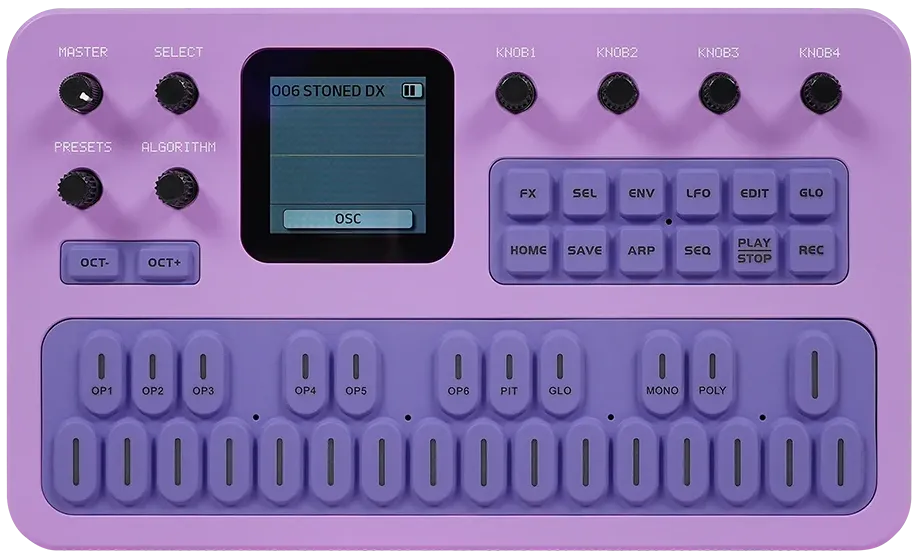
The M-VAVE FM-1 is a pocket synth, groovebox, effects box, drum machine, and sampler.
The stock version has a six-operator FM Synthesis engine and can also produce 303-style basslines and an 808 drum machine-style engine. There’s also a ‘chiptune’ synth, pluck synth, and the sampler, which shares 8 sampler slots across tracks.
Again, we haven’t actually held a unit per se, but the online workbench is a great tool to get started if you’re waiting on your unit and simply want to explore, or even test out different mods.
The community hacked it first
Similar to Akai and early Behringer products, the community ‘hacked’ it first. Starting in late September 2026, four separate groups launched unofficially supported custom firmwares within days of each other: Groove OS, SLOOP, Felucca, and XOX. None of which were officially sanctioned by the M-WAVE team.
By October, the number of firmwares essentially doubled, with Felucca alone shipping 10 releases within 48 hours of each other. With the custom firmwares, the $50 synth grew into a full groovebox with SLOOP, JIANT and Skiff adding new synth engines, sample playback and wavetable synthesis.
We’ve been toying with several different firmwares via the FM-1 Emulator, and it’s worth noting that not all firmwares run smoothly in the emulator, which leads me to believe the same may happen for the unit itself. However, for the mods like Argo, an expansion of Felucca with added synth engines, or Orbit, a simplified, more fun visual version, they work very well and are fun to create on.
It’s worth noting that if you start collecting firmwares like they’re free VSTs, then it would benefit you to read through every single user guide with each new build; the layout and function of the encoders change. SO at first it’s fun to bounce around and explore; however, if you want to discover what each build truly has to offer, then it’s best to read through the provided user guide or manual. You may have to search for them in the description or the release notes; each developer has their own way of providing this.


If you’re liking what you’ve read so far, or have a unique opinion on the M-VAVE drop your comments in the chat. We’ll be part of the M-VAVE family too real soon.

M-VAVE’s Response
Normally, or shall we say ‘in the past’, hardware companies have been quick to cull the accretion of open source communities around their hardware, often staring down reverse-engineered firmware with bricked updates, tight lips, and general non-acknowledgment. However, M-VAVE chose a different route.
M-VAVE isn't historically friendly to the open source community, not that they’ve been hostile in any way,but the tight-lipped disposition for years would lead one to believe that they were closely monitoring the situation. Similar to Akai, their sudden acceptacne/adoption/ endorsement or whatever framing fits comes as somewhat of a surprise yet a smart play.
In a world where agentic coding had migrated into the music creation space, seemingly hardware devices/ analog workflows would be a ‘nice’ avenue for music creators; however, by endorsing the open-source community, now companies like Akai and MVAVE have made their hardware more valuable than ever.
MVAVE takes this a step further by enabling their online ‘workbench’ where virtually anyone can poke around and play stock instruments, edit projects and manage samples, or even flash a build directly from the browser.
To any brand that is now watching this new era of agentic firmware hacking, modding, and developing, your current firmware is no longer the ‘big asset’ . While still proprietary, what’s most valuable in this ecosystem is the ability to continually support development and provide a workspace for exploration. From our standpoint, MVAVE’s approach with their workbench has instantly made the device a ‘no-brainer’ purchase. If a simple $50 handheld synthesizer can become ‘anything’, the need for additional peripherals that support the creative workflow means more than additional plugins. So don’t sue! Support.
Then… it exploded
And exploding is a simple way of putting it, seven major firmwares shipped by November 2026, SLOOP, Felucca, FM-1+VA, XOX, Jangada, Groove OS and FonMni. But these are just the ‘best of the best,’ with FM-1+VA essentially patching the stock firmware.
Less than a week later, there are more than 108 different firmware types.
Steve Duda from Xfer Records shipped the free SHRUB firmware, which essentially puts Serum on the FM-1, complete with a browser, Web MIDI editor, hardware emulator, and VST3 companion. The SMK-37 Keyboards feature the same chip as the MVAVE-FM-1 (JieLi AC791N) so many firmwares were ported there as well.
By mid-October, there were over 260 hardware hacking projects across 19 different brands. The FM-1 is only one drop in a wave of open-source projects influencing Behringer and Akai.
We’ve had some time to try different firmwares and honestly its tough to decide, which is why we’d more than likely stick with the stock firmware, opting to learn that before venturing out into the unknown.
Why it matters for the MPC
M-VAVE set the template: a brand that is willing to embrace the hackers instead of ignoring them or, worse, suing them. And the wave has already reached the Akai ecosystem, well before the FM-1.
The major factor here is the cheap hardware combined with community firmware, and vibecoding shows that the community behind Akai products is a bit larger, but it’s the same movement, bigger scale, and essentially more at risk.
But Akai should take note of projects like Vitaleon and Drey Anderson; while building the Vital port for the MPC plugins, they are also ranking FM-Firmwares. Ave McRee, Taetro, and other creators are also exploring these devices.
When looking at the FM-Firmware ‘repositories,’ there are so many options, and we can see so much potential for the MPC community. Ideally, the shift for Akai comes in a hardware package and not more plugins (where they’ve been headed with the MPC for the past 3 years). We don’t need a new SSL emulation, or if we do, it's not provided by Akai at a cost. It comes from the SSL/Duende team that supports the open-source efforts of the community.
Akai hit a home run with the MPC sample, and ideally they’d look at devices like the MPC Sample Key and Akai Force G2 as a giant sandbox for firmware development.
Eventually, 3D printing and cyberdecks will become more available to the average user. Without integrating into these open source/modding/vibecoding communities, Akai runs the risk of losing their customer base to cyberdecks and custom-computed builds. Behringer has already shown the willingness to develop products at a fraction of the cost that directly compete with the Akai product line. These trusted brand names should stake their claim in the ecosystem before they are completely boxed out.
Can I Trust Open Source Builds on My Hardware?
Honestly? Yes and no. Some of the newer Unis do carry a different flash chip that some firmewarews dont recognize. Saves van vanish as soon as the device turns off.
There have been some virus warnings from the community; however, they’re not independently verified as of this article’s creation, so we can’t say it’s a fact. However, it’s smart to assume that risk.
It’s possible to re-flash back to the stock OS; the Workbench features flashing tools specifically for this purpose.
We’d advise doing a bit of research on the devloper/team before you flash your device, and to back everything up JIC. Otherwise, use at your own risk.