

How to build a real brand as a musician or artist. From core identity, visual branding, and consistency to the backend business. We cover proven music-industry frameworks, not guesswork.
Artist Branding: Concept to Execution
Most independent artists treat branding as an afterthought. Or just their personal identity when posting online. A consistent post grid or camera shot, logo, or outfit. All of this bolted on after the music is completed. But according to industry professionals, branding a music identity actually works the other way around.
The artists who build something long-lasting start with their identity way before they touch any music, any visuals, or any outfit. Every single decision they make, whether it's album cover art, their merch, how they structure their online persona, or the music, is built downstream of their artist identity shift.
TLDR:
Your branding as an artist is when you’ve decided on more than a consistent identity. Everything about your presence as an artist, from your sound, your visuals, your values, your voice,e should be consistent across every touchpoint. Your core identity can be authentic to yourself, or a creation of your own, eithe way this needs to be something that remains fixed. Extend this personality across visual and audio elements. All of this material identity can be protected legally, including your artist name and likeness. Brand identity + protection is what helps you position yourself competitively in the marketplace.

Stop paying rent on your own music.
Most distributors charge you every single year to keep your existing catalog online. If you stop paying, your music gets taken down.
LANDR lets you release your tracks and know they’re up for good. Plus, you get AI mastering, plugin access, and seamless distribution all under one roof.
👉 [Keep your music online forever with LANDR — Get 20% Off]
Use Code Below for 20% Off A Mastering Plugin or Subscription
What Branding Means For An Artist
Often the word ‘brand’ gets treated as some prohibited phrase among artists and musicians. Something ascribed to sneaker companies, not songwriters. But in the industry literature, brand doesn’t actually mean ‘manufactured person’
Bobby Borg, a working musican/educator has written multiple reputable texts for musicians and defines branding as a foundational step in an artist’s marketing plan. This includes deciding on an overall brand ‘structure’, naming, visual, and USP before a single dollar is spent on any promo or ads (Borg 2022)1. That order matters. Once this is complete, then your packaging and market position come, not the other way around.
Ari Herstand’s How to Make It in the New Music Business, widely used in music business curriculum, completes the frame:
A fanbase forms around your identity, not your sound; the audience will attach to a whole ‘persona ’, not just the sound; the persona is the ‘why’ behind the music, not just the audio itself (Herstand, 2023)2. That's the whole purpose behind your brand: to give your fans something solid to hold onto.
The Two Layer Model: Brand Identity Framework For Artists
The most widely taught and adopted framework in branding comes from marketing expert David Aaker, whose Building Strong Brands introduced the concept of the ‘brand identity’ or ‘brand vision’. Aaker’s model is split into two layers.
Core Identity: The essence of the brand meant to transcend time. These ideas of the brand should remain fixed even as the brand evolves.
Extended Identity: This is the featureset of the brand that adds uniqueness and textures. The personality, these are the visual codes, origin story, and partnerships/associations that bring brands to life (Aaker,1996)3
The practical application to an artist will help reframe a lot of innocuous branding mistakes. Simple logo redesign, color palette adjustment, or simple rebranding of product names (like sample packs, albums, clothing lines, etc.) are extended identity changes. Those absolutely should be flexible over time.
BUT if an artist keeps changing their sonic identity, their core identity/values, or the emotional space they occupy as an artist, they are effectively rewriting the core identity. That confuses an audience.
Aaker’s own writing on the model notes that a more memorable brand has a larger extended identity built around a stable core identity. Meaning the visual and stylistic variance actually works because the core is still intact.
Step 1: Define Your Core Artist Identity Before Designing A Logo
Before even thinking about your visual presentation, you need to know who you are.
Before any ‘mood board’ or ‘styling session ’, there needs to be a clear understanding of three key things:
Sonic Identity: waht is the specific sound that your artist project lives in, this should be described precisely enough that any random person could instantly recognize your music.
Think of the sonic signature of an artist like Seal, or Beyonce. From the arrangement to the mix, you can recognize these artists almost instantly.
Emotional Territory: What is the feeling the project is intended to invoke? This should be consistent (somewhat) release over release.
A great artist to think about is PinkPanthress; her music and branding have a consistent appearance. As a somewhat shy artist, having a brand identity along with a sonic emotional identity allowed her to break out of her shell4
The Artist’s “why”: what is the underlying motivation that anyone can connect with, especially your target audience? What will separate your song from just ‘any song’ (Herstand,2023)
Countless artists skip this step, and countless artists make this crucial branding failure. Borg identifies this in his marketing planning process; artists often speed directly into “what should my logo look like” instead of first answering some critical questions: “what does this project actually stand for?” Without this, your visuals may look good in isolation, but they don’t reinforce anything about your artistry other than graphic design.
Step 2: Craft Your Extended Identity: Visuals, Voice, Story
Once you’ve got your core identity locked down, the extended identity is the fun part you build around it. This can be your naming, your brand structure, or even sub-brands; this encapsulates your entire ‘experience’. Your voice, your captions, your artist swag, your email newsletter, typography, imagery, etc. all live here. And the beautiful part is none of this needs to be expensive or complicated; it needs to be consistent. Consistency is what turns a collection of posts into an identity rather than your scattered day-to-day bs.
Case Studies:
[Pink Pantheress]
Built on personality and control, letting the music speak first
Posting from an authentic place, Pinkpantheress decided to let her music speak instead of oversharing5. Sonically, she occupies the same space. She demands control, and everything from the visuals to the Instagram feed is curated from a place of authenticity.
This is a clean and clear illustration of “brand as a person” perspective. The personality perspective is restraint, and this has stayed consistent as her brand has scaled to arena tours and Grammy nominations.
[Kaytranada]
extended visual identity supported by strong sonic identity
The distinct sound of Kaytranada is influenced by the likes of J Dilla, Parliament Funkadelic, and Janet Jackson and is as formulaic as the latter. Kaytranada has found his niche in drum sequencing, programming, and even tempo.
The eclectic artisan personality extends outward into his album art and visuals, an example of extended identity through visual language. This reinforces his core genre-bending production.

Step 3: Market Positioning - Finding Your Lane
So this is how your brand gets deployed competitively. This is the subset of everything an artist can say about themselves that can be emphasized in a specific market. Borgs marketing framework approaches this as a sequential process; Identify your most likely audience, study who is currently serving that audience, then define and exploit the opportunity.
So, as an artist, this means avoiding the phrase or idea “a little bit of everything.” You may have heard your favorite pop star saying this on their independent run, but this is career suicide for a new artist.
Broad genre description like “hip hop and RnB” is not a position. The position is the answer to this fundamental question: “Why would someone listen to you over the 50 other artists doing something similar?” What is your unique position?
Consistency Is Your Secret Weapon
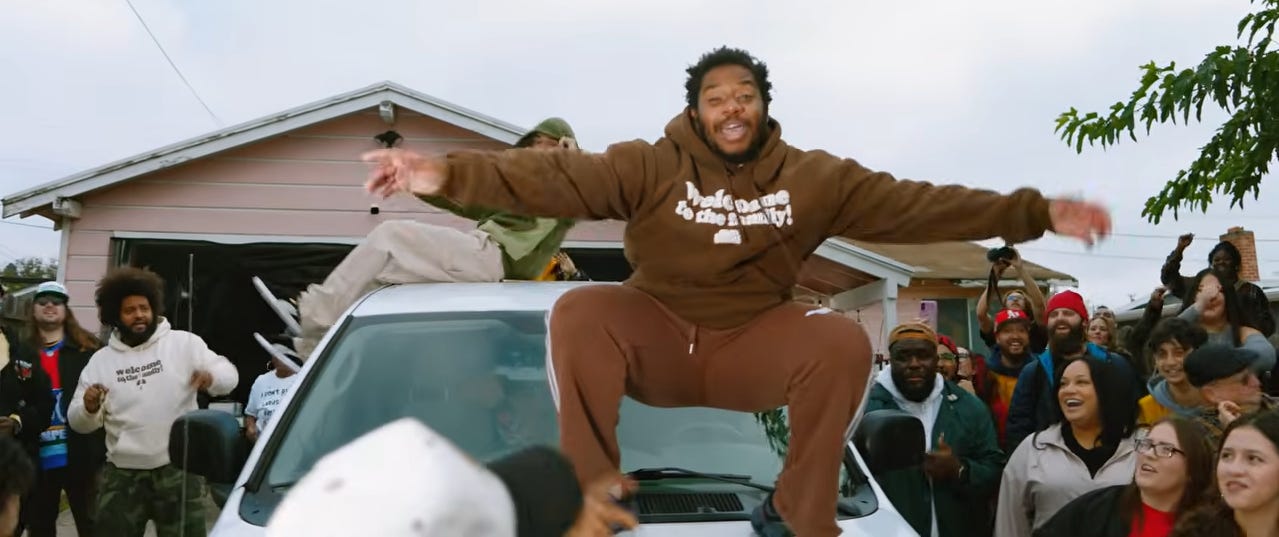
Like laRussell, identity and position only pay off if they show up consistently in the same way everywhere. From cover art to socials, merch, live setups, press materials, etc. Everything about an artist’s image doesn’t have to be perfect, but consistent.
Your fans should be able to tell your posts apart from a stranger’s without seeing your name. This can seem like an impossible feat; however, if that’s the case, chances are you’re starting here instead of identity. Borg describes this as ‘delivering on the promise of the brand’. LaRussell does this extremely well. His brand started as something small, and that idea was able to scale to the masses as a finalized product.
Brand Protection -
[Trademark and Ownership]
Your brand isnt just your creation, its your legal asset. This is a critical step to make as an artist: the mental shift from artist to brand. Once you use your stage name commercially, it’s essentially functioning as a trademark. However, just performing under the name does NOT give an artist enforceable national rights the same way a federal trademark does6. You can spend years building a business around a name only to discover someone else owns the mark. Registration helps to prevent this.
Donald Passman's All You Need to Know About The Music Business [sometimes called the industry bible] identifies the artist's brand as the asset that labels want a stake in. The master recordings, while valuable, don’t retain the same value as a name and identity7.
Myth: Branding = Manufactured Swag
A common misconception is that an artist’s brand must be some alternate ego or some made-up swagger separate from the artist themselves. There’s NOTHING in the established framework that states this. Brand as a persona is about personality traits, the same as a person, but when thinking of a brand it's referred to how audiences relate to genuine human personality. This isn’t some mask to slap on; that may actually have the opposite effect. Fans dont attatch to fictitious personas, they attatch to a real point of view across releases..
which leads to the next point.
The Real:
Branding is not a launching event. It’s not a milestone or something you slap together before your release, then never address again. This is a framework, a living system that guides every future decision. The actual work isn’t the mood board or the business plan; it's the discipline of checking every single touchpoint against your defined identity.
Recap:
Establish Your Core Identity First
sonic identity and emotional landscape first. This will help set the stage for the artist’s " why." Do this before any visual work starts.
Analyze Your Competition
Identify 5-10 artists that are in your niche or serving a similar audience. Name what has been taken, and what hasn’t.
Define your position
This is the one liner, the one sentence why your artist project resides in a place nobody fully occupies, what makes you unique.
Build Extended Identity
These are the systems that help lock in your brand identity: visual systems, your tone of voice; all of this expresses (not defines) your core artistry.
Audit For Consistency
Every time you’re visible as an artist, treat it as the stage. Every release, art, social post, merch gets contrasted against your artist identity.
Trademark Your S**!
Doing a TESS Search is step one; make sure you register and file a trademark before working for years on a project you’ll never own.
Revisit, Recycle
Treat your brand as a standing reference system for what works and what directions your new releases should stay in.
Key Takeaways:
Brand Identity has two distinct layers - a fixed core identity and a flexible extended identity. Most branding mistakes come from focusing on the wrong one.
Positioning is specific - This is the unclaimed intersection that the artist occupies. Who exactly are you making music for?
Your Brand is an Asset, legally - A recognizable name is a legal asset. Common law use will not protect your artist brand; treat this like a business and protect your assets.
FAQ:
Q: Is branding the same thing as marketing?
A: No, Marketing is how your ideas and identity are communicated and promoted. Branding is the identity itself. Effective marketing is built around strong branding
Q: Do I need a logo to have a brand?
A: No, A logo is a piece of the extended identity; the sonic identity and emotional territory matter more than the logo.
Q: How often should an artist brand change?
A: An artist’s core identity should remain stable for years; the extended identity can and should evolve as long as the core brand identity remains intact.
Q: Should I trademark my artist name before release?
A: If you don’t have an audience yet, it will be hard to justify the cost; however, the risk of waiting is also real. Once you’ve built some recognition around an unregistered name, there is no guaranteed right to keep it if someone else already holds the trademark.
Q: What is different between positioning and identity?
A: Identity is what your brand could stand for; positioning is the subset of that identity that is emphasized to stand out in a noisy market.
Q: Can a brand be too consistent?
A: Consistency in your core identity will lend more flexibility in the extended identity. A stable foundation is what lets you vary your visuals and format while still reading as the same core artist.


Borg, B. (2022). Music marketing for the DIY musician: Creating and executing a plan of attack on a low budget (3rd ed.). Rowman & Littlefield.
Herstand, A. (2023). How to make it in the new music business: Practical tips on building a loyal following and making a living as a musician (3rd ed.). W. W. Norton & Company.
Aaker, D. A. (1996). Building strong brands. The Free Press.
Xue, F. (2025, September). PinkPantheress manifested this. Coveteur. https://coveteur.com/pinkpantheress-cover-interview
Grant, K. (2021, August 25). PinkPantheress: The 'breakout' singer who's happy to be a mystery. BBC News. https://www.bbc.com/news/newsbeat-58319555
Rosier Law Group. (2025, September 25). Stage names, band names, and trademarks: What every artist needs to know. https://www.rosierlawgroup.com/intellectual-property-law-firm-blog/stage-names-band-names-and-trademarks-what-every-artist-needs-to-know
Passman, D. S. (2023). All you need to know about the music business (11th ed.). Simon & Schuster.