


Topic: The Great “Ethical” AI Deception: Openbeat, Suno, and the Creator Fallout
Date: December 10, 2025
Filed Under: Industry Expose / AI Ethics
Author: SOVLTRON
🚨 The “Ethical” Facade Crumbles: Inside the Openbeat AI Scandal
The promise was simple and seductive:
“Ethically Sourced AI Music.”
Shout out to Shawdi P, and Weaver beats for exposing one of the biggest scams to hit the music producer community since Timbaland’s beat club. While not related, there’s a bit of congruency between the types of characters that align themselves with the 'this benefits the producer community’ ideal and somewhat ambiguous origin companies they are aligned with.
While we typically don’t do this type of content, it’s ever more important to stay abreast of what can potentially affect all areas of the producer community.
While the music industry is seemingly at war with AI companies and machine learning, behind the scenes, they may be creating pathways for profit, potentially endangering the sovereignty of artists and their creations. While certain companies thrive on massive catalogues readily available for pennies on the dollar, or even free in some cases, OpenBeat AI steps in as the proverbial “good guy” to save the day. Or so we thought.
They touted themselves as “ethically trained” and even brought on spokespeople or creative directors like MyGuyMars to build rapport with the community, stating the model was trained using his “chords, drums, and musical emotion”. Marketing themselves as the safer alternative to Suno, they touted no shady scraping, no mystery database or dataset, no lawsuits, just “ethical AI” using a clean interface with an on-time, lifetime license.
This was the perfect pitch for beatmakers/producers who
find it unethical to steal or train AI models on artists who haven’t consented or are not being compensated
Don’t trust the current AI copyright madness
want to experiment with AI tools without affecting their reputation or personal values.
But unfortunately, as we’ve learned this week (and maybe too many times before), if it sounds too good to be true, it most likely is just a cash grab for a relatively successful artist and a wrapper for Suno.
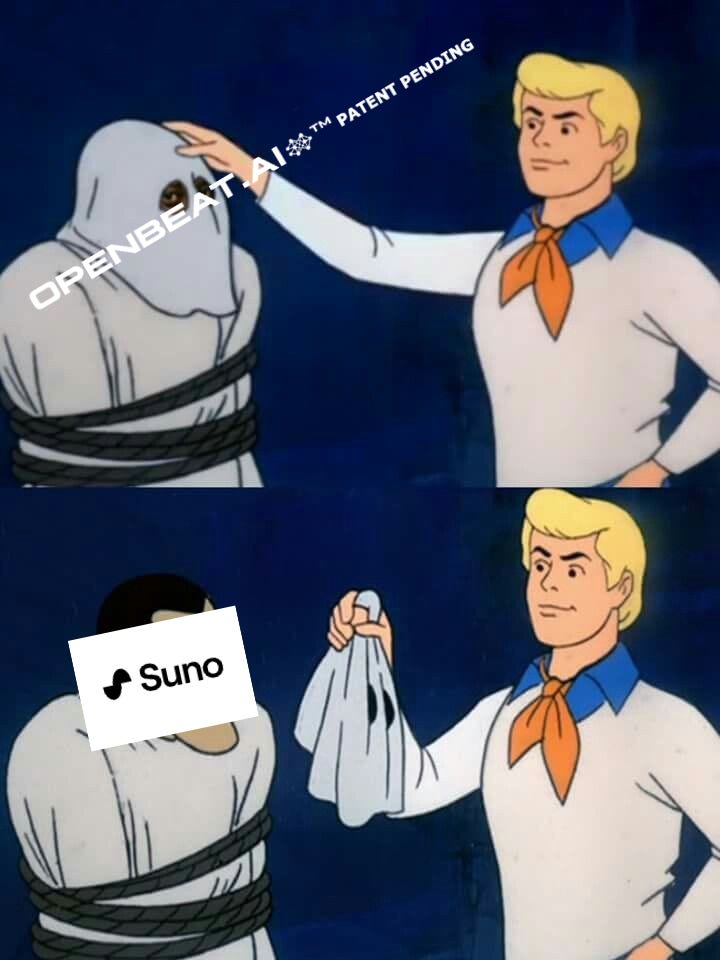
We stumbled upon this story simply following another story, which was controversial in itself. Apparently, there are a few creators who are a bit less than liberal when disclosing they are promoting products as part of paid partnerships. Big shoutout to Weaver beats, as during his research on the topic, he apparently discovered what Shawdi P discovered a few days prior.
Apparently, Openbeat AI was never “ethically trained”; in fact, they may not have any method to ‘train’ their ‘AI’ at all. According to multiple technical breakdowns, community investigations, and simple inspect page checking on your browser, OpenBeat AI is simply a front-end website that quietly passes your prompts to Suno using an unofficial API service or API.box method and repackages the Suno output back to you at their current markup.
You’ve pretty much got the gist of it; however, there’s more nuance and a deeper level of discovery and analysis to be had. So sit back, enjoy yourself, this is the full stoyr of how a ‘revoluationary’ “patent pending’ tool was exposed as a deceptive middleman, deceiving not only the users, the promoters but potentially even any investors into the compnay, the creators caught in the crossfire and why this cocoughany should permanently change how you approach using AI tools as a producer.
🕵️ The Whistleblowers: Shawdi P & Weaver Beats
While it’s true that Weaver Beats lit the charge and blew the lid for the wider producer community, the charge was set elsewhere. To keep it honest and give credit where credit is due, Shawdi P The Plug was the first canary in the coal mine who carried the dynamite in his tiny little beak, setting the charge for anyone who may have stumbled upon his humble work.
A few days before this expose took off, Shawdi actually dropped a video digging into Openbeats’ TOS and marketing promises on his channel. In his video “The HUGE Problem With AI Music | Openbeat.AI and “I EXPOSED Openbeat.AI (And They Responded), he identifies the core contradiction of the service. Openbeat publicly brands itself as ethically trained, while its TOS quietly pushes all copyright liability onto the end user and openly admits that its generations may resemble copyrighted works.

The front page pitch:
“Ethically trained AI”
“We own our data.”
“Safe to release.”
The Terms of Service:
You (the user) are responsible for any copyright infringement
Your uploads can be used and reused by the platform (and possibly its partners)
Generations may resemble existing copyrighted works
If you truly own your API, tightly control your data, and ethically train your models, you don’t have to throw your users under the legal bus. Credit is due where credit is due; Shawdi P is the first one to say the quiet parts out loud.
Then came Weaver Beats.
Working with a Discord user name FEX and other community members, weaver dove into the technical side instead. In Weaver’s coverage, he walks through simple page inspect logs and network callbacks to show that Openbeat wasn’t actually generating anything locally or on their servers. In fact, the prompts were actually being sent through an external service known as an API box. The said API box was actually Suno’s servers, where the file was generated and then relayed back to Openbeat AI.
In plain English:
You thought you were using OpenBeat.AI, but in fact, you were using Suno through OpenBeat with an unofficial (potentially unauthorized) Suno API. Your ethical track was not ethical at all, rather a Suno creation labeled as Openbeats baby.
And Weaver wasn’t the only one to confirm this; multiple Reddit forums, as even DJ Pain1 himself, and Openbeat, through a public statement, confirmed that Openbeat was using a Suno API through API box.
Reddit+3Reddit+3Reddit+3
🧩 How the Scheme Actually Worked (So You Don’t Fall For It Again)
Let’s step back and analyse this for a second, like gain-staging: Step by step, so we can really understand what’s going on.
You notice that AI is inevitably permeating the market, and not wanting to be out of the loop, or seem like a dinosaur, or simply from pure curiosity, you’re interested in how you can incorporate AI into your current music-making. Perhaps you’ve even heard a few good AI songs and believe in the technology as long as it’s trained ethically, which at this point may be incredibly difficult.
Along comes a company promising everything you’ve been concerned about
You see the YouTube/Instagram ads with terms like ‘ethically sourced’, ‘better than Suno’, ‘No subscription’, ‘lifetime access’, ‘safe to release on Spotify.’
Influencers you believe in and trust who have the same values as you support, use, and recommend the product. "(DJ Pain 1, Ave McRee, BOLO) and are offering promo codes to support their channel while showing how the model uses user input to create astonishing results.
You decide to give it a shot, you sign up for an account, briefly skim the TOS (if that), and start creating with a few free credits they offer.
You upload original stems or record your vocals and melodies into the software.
Unbeknownst to you, the scam has been going on since before step one, but with your input, Openbeat forwards your ‘request’ to an unofficial wrapper, which connects your prompt to Suno’s backend.
Instead of Openbeat doing any work, they simply allow Suno to do all the heavy lifting, and Suno generates an audio file.
That audio file is then returned directly to Openbeat in a matter of minutes and saved on Openbeat’s servers.
After a few moments of waiting, you’ve finally got your output. Openbeat hands you a regifted package they got from Suno as your brand-new Christmas gift. It’s wrapped in a nice ethical wrapper, and you feel good that you haven’t contributed to the firestorm of copyright infringement that is the company Suno.
This is why this hits a little differently than a normal API integration. Sure, they can utilize another company’s API; they even disclose this inside their TOS.

They seemingly are doing what should be done when using a public API.
Being transparent about it,
Respecting the terms
And being honest about not having their own proprietary model
But OpenBeat is actually doing the exact OPPOSITE of every one of these ideals.
They aren’t being transparent about what API’s they are using; in fact, they are publicly positioning themselves as the ethical alternative when, in fact, they essentially ARE Suno. The quintessential bait and switch.
They tout ‘patent pending’ on their site, but how can you be patent pending while primarily utilizing a public API, let alone Suno’s, which is actually patent pending?

⚖️ The “Ethical” Lie: Why The Suno Connection Matters
I’m sure you may be saying to yourself, “But why does this even matter?” AI is inevitable, and people use public API’s all the time.
Well, to understand why the producer community is in such an uproar, you’ve got to zoom out and look at the bigger legal war around AI-generated music.
Flashback to June 2024, the RIAA (on behalf of Sony, Universal, and Warner sued Suno and Udio, alleging they trained their machine learning systems on massive catalogues of copyrighted recordings without permission
According to the accusations and follow-up filings, Suno and Udio:
Copied ‘decades’ worth of commercial recordings to train their models
When prompted with certain cues, generate tracks that strongly resemble or imitate human artists and songs
bypassed YouTube’s protections by ripping audio from streams to circumvent DMCA
And Suno does not deny training their models on copyrighted music. In court and in public commentary, they lean heavily on a ‘fair use’ defense.
At the same time as the lawsuit, the reality around the music business is shifting.
Warner Music settled its lawsuit with Suno, flipping it into a licensing partnership with plans for licensed AI models to debut in 2026
Artists are filing class action lawsuits, testing different angles, and including right-of-publicity and vocal likeness.
From the legal standpoint, the question still lingers: is Suno’s machine learning technology ‘ethical’? While there isn’t a clear yes or no answer yet, here’s what is clear.
The fact that Suno’s training practices are actively contested by rights holders, including artists, publishers, and labels, is significant.
Multiple lawsuits have claimed their methods are essentially copyright infringement and exploitative to the artists.
Any model built on scraped catalogs without the express consent of or compensation to the copyright holder should not be labeled ‘ethically sourced.’
So that brings us back to OpenBeat:
Their entire USP was “we are not Suno,” “We are the alternative to all that grey area nonsense,” “We’re trained on in-house musicians and licensed session.”
With that as your core promise, you don’t get to quietly plug into Suno, the very model at the center of the controversy, and sell it as a makeup as ‘safe’.
That's a direct lie.
THAT is why people are calling it a scam
It’s not just a tech oops or misunderstanding of how API’s work.
📉 Collateral Damage: Producers, Rights, and Real-World Risk
Not everyone is in an uproar about this; however, those who take offense are pretty vocal about it, with the loudest reactions online about hurt feelings, infighting, ‘who’s fake’, and ‘ who to trust’. While melodramatic seeming, their outcries have some validity.
Distribution risk
If you release OpenBeat/Suno-generated tracks to Spotify or other streaming platforms, you may be bound by distributor TOS that assume you’ve cleared the rights to the music. If Suno’s training is ruled an infringement in the future, your catalogue is at risk of being flagged, frozen, or quietly taken down from the services.
Contractual Risk
Consider if you’re signed to a label like Warner Music, they could have clauses in your recording contract about using unlicensed samples or third-party generators. Especially those of which they are not in bed with. Using an “Ethical AI” which turns out ot be a thin layer over controversial and disputed technology puts you in breach of contract territory, not the company that sold you the subscription.
Data Risks
Uploading unreleased stems to AI tools is already sketchy territory. Doing so into a black box wrapper that essentially sends the most sensitive parts of your music into a third-party data pool that you never consented to leads to a completely different level of recklessness. Several aspects of the TOS indicate that your uploads can and potentially will be used to improve the service, but what service? Openbeat, Suno, or Both?
Reputational Risk
In this moment, when producers and artists are becoming more wary of the source of their creations, you can use DJ Pain 1 and Timbaland as a study for how quickly your reputation can go from being a G.O.A.T. or ‘trusted educator’ to sleezebag for simply aligning oneself to the ‘wrong side’ of artists’ interests.
This is bigger than picking plugins, or choosing samples, or even a recently controversial topic, using loops sourced from overseas producers. Inevitably, you’re choosing a legal position, one that may or may not stand on the side of creators like yourself
🎙️ The Fallout: The Creator Apology Tour (and the Ones Who Opted Out)
So now that we understand how this ‘scam’ worked and the risks associated with it, we dive into the fallout (which, as of this writing, is still kindof happening)
Weavers exposed forced almost every major influencer who promoted OpenBeat in the hip hop/beatmaking ecosphere to say something.
Starting with the most accountability taken by a producer is
DJ Pain 1: The Accountable
In all fairness, DJ Pain is probably the most difficult producer to listen to, not for lack of great content, just for being monotone and uploading exceptionally raw, unedited videos. Unfortunately, he took the biggest reputational hit because his brand is essentially the producer’s advocate, teacher, and doesn't get screwed by the system mentor. While originally an expose on undisclosed or minimally disclosed advertising on YouTube, DJ Pain also found himself dead center for promoting the Suno-generated Openbeat AI tracks.
After being mentioned in the ‘expose’, DJ Pain quickly uploaded a video that took accountability for his role in promoting something that wasn’t what was advertised to the public or influencers.
He explicitly says he promoted a service that was likely not ethically trained.
Provided proof that Openbeat AI misled him, even after he expressed his concerns with the ethics around AI training models
Apologized to his supporters and the producer community at large without minimizing his role in the situation
Frames his mistake as a hard-earned lesson in doing better due diligence before co-signing AI platforms.
In one of his later videos, “OpenBeat AI Just Responded: Are They Using Sun?”, he walks through evidence of the companies’ shifting statements, including their quiet removal of the “ethically trained’ language from their site. Further putting the company in the fire.
Ranking his accountability, we’d call this a 9/10.
This is what accountability looks like. There are no ‘if you were offended’ statements, just a simple “I got it wrong, for that I’m sorry, here’s what I missed, and I’m looking to do better, going forward, here is what I’ll do differently.”
To make this a 10/1,0, we believe he should have done a bit more work or reached out to Weaver or Shawdi P directly to find a way to replicate this in his first video.
Busyworks Beats: The “Pragmatic”
Busyworks ‘ approach was more akin to a businessman caught in bed with a reputationally bad partner; would they continue in the partnership if no one knew?
In his livestreams and eventual video “Open Letter to OpenBeat. AI he
Looks past their longstanding feud and gives credit to WeaverBeats for a brilliant investigation into this company
Acknowledges that his platform drove users toward a deceptive product (though not focusing too much on the ‘ethical’ portion of the deception)
Calls out the bait and switch tactics of advertising, of throwing rocks at the enemy and secretly serving their interests using terms like advertising “organic beef” while secretly serving “factory-farm-mystery meat.”
Deletes or unlists his Openbeat AI content to stop funneling new people into the system.
While Busyworks Beats’ response lacks the affect of DJ Pain, the accountability is there; he relies on “This wasn’t transparent, and I can’t stand behind it.”
We give this accountability rating an 8/10
WHile Busy was accountable, Rather than spend the better part of an hour erroneously trying to compare a 128kbps mp3 file downloaded from Beatstarst to a wav file he produced in his DAW in an effort to prove Beatstars has AI generated tracks on the top 10 (which shouldnt be a problem since he continually uses Suno in particular during his content ) he could have focused more on the accountablity aspect and his role in leading users towards a service that he already recommends during his livestream.
Ave Mcree: The defensive, the nuanced, the completely erroneous
Ave Mcrees’ “The Truth about OpenBeat and Suno AI & My Apology” sits directly in the middle of accountability and defensiveness. While he does issue an apology, a lot of his argument centers on what his intent was and being ‘compensated’ for his promotion
Ave emphasizes that he wasn’t paid by Openbeat and in fact reached out to them first… to promote their product … for free.
He frames his use of the tool as purely experimental and driven by curiosity, though also claiming in previous videos that AI sampling would be his go-to method to avoid getting his videos taken down. Especially using services like “soundraw.”
He expresses regret that his content may have misled people, but also pushes back on the premise that he was complicit.
Honestly, without making any direct accusations, here is the reality behind Aves’ accountability.
Rating = 4/10 .. Not quite complete bullshit
Having posted several tracks using the service, it seems that Ave was more frustrated with being involved in the controversy than he was about OpenBeat being a wrapper for Suno.
Ave has repeatedly promoted OpenBeat on his channel in addition to other controversial products aimed at producers.
Ave also erroneously tries to explain what an API is and how that is technically not unethical, which honestly would lead to a further decrease in his rating, the longer we write about him.
At the very opposite end of the spectrum is BOLO
BOLO Da Producer: The Unapologetic/ I make beats on my channel with whatever I like, so what?
But we kindof already knew this.
On his livestream “OpenBeat.AI Situation is Weird” and later discussion/interviews, his attitude fluctuates from basically :
I use cool tools to make beats. OpenBeat is one of them
I’m not losing sleep over what they do with their business
The producer community loves drama too much, and I’m not playing into it
I do also find it ironic, however, that he chose to single someone out in his livestream who was talking shit and on Weaver Beats live chat asked numerous questions about the usage of AI rather than make statements or provide context, which seemed rather off topic.
To his credit, after being invited to a conversation with Weaver, BOLO adamantly says that he will not be vetting companies any more than he already is and that he doesn’t have the time to rather than focus on the music production aspect.
His position is that if he sees something that he likes, that’s dope, he’s gonna make beats with it. Which is understandable, to a degree, but here is where BOLO fails to see who he is and what his role is.
BOLO touts his streaming numbers due to his role in the song “Whip/Nae Nae?” and that he doesn’t need to do YouTube videos. BUT he’s still in talks with companies to do just that. So to some degree, the channel is important to the business that is BOLO Da Producer.
What makes it possible to do tutorials, interviews, deep dives, and criticisms that people are interested in watching is this certified credibility. Way fewer people would care without a smash single like “Whip/ Nae Nae”. So, for the people who watch and trust his advice, you've inadvertently led them into the potential traps that we described before. All while saying, “People don’t really know how the legal stuff works when it comes to music.”
Again, the take is based, but like his livestream, he’s seemingly talking out of both ends, and the accountability is nonexistent. Fortunately for what he lacks in accountability, he makes up in perceived amiability.
Accountability rating 1/10: This MF just doesn’t care
Larry Ohh: Apology on top of Apology on top of Apology
While writing this post, Larry Ohh drops a video apologizing over and over again for misleading his community, drops multiple free packs from his archive (with ZERO opt-in in just a straight drop link), offers a course for free, and everything.
Accountability Level 9/10 Could’ve done more sooner, but great job.
🤝🏽 Influence, Money, and the New Due Diligence
This situation isn't just about one company; it’s more of a case study in how quickly misleading or false marketing tactics can blow up in a company’s face, AND how quickly an “ethical” AI brand can be sussed out.
As it currently stands, there is a legal vacuum around training data
Producers are looking for safe shortcuts to making great music quickly
Influencers are under enormous pressure to keep up and be a part of the next big thing, to keep the attention of their audiences
More uncomfortable truths:
If you’re an influencer, “I didn’t read the Terms of Service” is the lamest defense, and is not excusable anymore. At this juncture, ethics matter. Great businesspeople care if their partners are cheating.
If you’re a producer, “But they said it was ethical” won’t cut it or even matter to your distributor, your clients, or a judge. YOU are responsible for what you put your name on.
“Wrapper services” are super common in SaaS and AI; however, the ethics depend solely on disclosure. Using API’s is 100% okay and normal; however, using an API and calling it your own ‘Patent Pending"‘ proprietary “ethically trained model” is not.
We’ve surpassed the point where you can treat AI tools like cracked VSTs. These are legal objects in the landscape now.
🧭 What “Ethical AI” Should Actually Mean (Checklist for Producers)
So where do we go from here?

Well, if you’re serious about not setting yourself or other artists up and adamant about using AI in the future, here is a bare minimum checklist you can run on any AI music tool before you put your name on it.
Training data transparency
Understand it takes MASSIVE amounts of data to train an AI model, MASSIVE like the entire Spotify catalogue.
Is there a clearly understandable statement about what type of data they trained on? Licensed libraries, in-house sessions they own the rights to, public domain, CC-BY, scraped from the web?
Are there names or specific catalogs that can be plausibly verified?
Legal Posture
DO they publicly disclose what API’s they are using, or if they developed their own API or machine learning algorithm?
Are they currently being sued or using an API of a company that may be under legal scrutiny?
If yes, are they still saying their stuff is commercially safe? If so, RED FLAG!
Data handling
What happens to your uploads? Are they training the model as well, or are they permanently deleting? If so, how are they deleted?
Are your uploads stored? Or shared with a third party?
What is their Business Model
One-time ‘lifetime’ deals on top of someone else’s API are not sustainable. If it looks too good to be true, it more than likely is.
Community Feedback
Google the company and look for what users on Reddit or other trusted forums are saying. If the feedback isn’t good, take it at face value that you may need to do more investigating before signing a TOS.
What are the Terms of Service
Does the marketing language say things like “ethically sourced” and “we own our data,” while the TOS says “you are responsible for any infringement?” "or “ Your uploads may be used to train the model"?”That’s exactly the pattern Shawdi P called out, so watch out
🏁 The Bottom Line
Let this OpenBeat AI drama be a wake-up call
Right now is the wild west of AI music, where terms like “ethical,” “Fair use,” and “licensed” are being thrown around as simple marketing tactics. It’s akin to the NFT world; it’s going to take some time before regulation catches up, and these companies will be long gone before that.
For producers: Trust but verify is nearly dead. If a tool claims to be ethical, you can pretty much assume at this juncture that it’s not. Unless you’ve discovered a massive number of musicians who have all claimed to be actively working on a model to ensure that the model is ethically trained, it’s probably not real. And if it is real, it’s definitely not going to be a one-time fee.
Even then, still ask for taiing data sources, licensing partners, and what happens to uploads, and if they are using a third-party API>
For Creators: The reputational risk of promoting AI tools is pretty significant. DJ Pain1 is a prime example of someone who has been at the front of the leading charge against unethical AI, only to be used in a cash grab campaign that only has big data’s best interest in mind. What was well-intentioned can go terribly wrong for your brand. However, his response is also what real accountability looks like.
For Songwriters: If you’re a songwriter considering how powerful the tool is to produce records you couldn’t otherwise sing, also consider how powerful the connection is between humans., theres nothing limiting you from using AI as a tool to get ideas to humans who can provide the real human emotion.
For the Industry: AI is nothing new; however, the SUno lawsuits and recent settlements prove there is real money to be made from AI. There’s also real pain, licensing deals will be cut, new careers will be made, and others will still fight for fair use. But square in the middle is the ethics of disclosure. No company has the right or an excuse to lie to its users about any aspect of its product. If you’re utilizing AI, be honest about where it comes from; you may find that people’s positions will change, especially with hit record after hit record.
All in all
Oppenbeat tried to sell us some bullshit. A bridge between ethical AI and what we know to be true, big data is in music wholeheartedly, and there are only a few players that can really make a difference in the game. Those being sued or currently working with the major labels.
As a toll booth to Suno, I would only expect to find very similar dealings in the future, only wrapped up in prettier wrappers or even those that fully disclose where their data is sourced from.
As of recently, there has been pending legislation that aims to limit state regulation of AI.
In the words of Tyler, the Creator…
It’s getting Stickyyyyy.
.
Read the terms. Follow the money. Ask ugly questions before you press “generate.”
SOVLTRON - Written for the Practical Audio Lab.
Lol
I'm about eight years behind the curve here but that was a great write and a fascinating read. Thank you :)