


NO, THE NEW MPCs DON’T SOUND ANYTHING LIKE THE OLD ONES!!!!!
Why? Well, It’s a "James "Ting" - (in JaFaikean accent)
*Updated* June 25 2024-
Often in the sonics conversation, opinions weigh more than facts. Rather than speculate and offer my personal opinion, here are some facts about the whole “MPC sonics debate”.
Sampling other people’s drums and sequencing with the MPC were totally unexpected. The machine was really meant to be a drummer, with better sounds than Roland's drum kit sounds available at the time. Roger Linn, creator of the Linn Drum and the first MPC, wanted to use Acoustic sounds for the drums rather than Roland's synthesized emulations.
Use Wayback Machine to read this
Eventually, Roger Linn would see the opportunity in the idea of ONE person doing multiple things or EVERYTHING in the studio and designed centerpieces to sync them all. Having invented one of the FIRST drum machines with SMPTE, the Linn9000, he was going to improve on its flaws and really change the game. But not being an electrical engineer, just a programmer, his designs had crazy issues... This is where Akai Electric Co. Ltd. comes in. https://www.attackmagazine.com/.../roger-linn-swing.../
When Akai released the MPC60II 5years AFTER the $5000 release of the MPC60, they ONLY added a headphone jack and a cheaper case.... Same price point... $5000... in 1991, Equivalent to $11,212.33 today... https://www.bls.gov/data/inflation_calculator.htm
Thank GOD akai switched from a studio electronics company to a CONSUMER electronics company. But did you ever wonder why? They left the audio market in 1991; actually, they were purchased by Mr. James Ting in 1992. https://www.forbes.com/global/1999/1115/034_01.html...
Believe it or not, Akai was distributed under the name Roberts until
They had been working on the MPC3000 with Roger Linn, releasing the final collaboration in 1994, which ended their relationship. Turns out one of the chairmen James Ting.. had a plan of his own. Seems he owed some people some money...as he had been planning this WHOLE thing since the 80s… after the market devaluation in 1997
He transferred Akai Holdings into Grande Holdings... stealing over $800 million in assets. https://www.scmp.com/.../hard-work-pays-vicious-akai...
Ultimately he was convicted, BUT Grande Holdings was actually the company that contracted ALL of aka is internal components..
So ever wonder why the MPC2000 is WAAAY different than the MPC3000?
As you can see... it’s a "James Ting"
Akai and Roger Linn weren’t doing well in the pro electronics market. Times were changing and they needed to produce cheaper products faster.. going years between thousand-dollar releases and having to service and manufacture designs was breaking thousands of electronics companies. Large and small
The smartest thing to do was to decrease production costs while satisfying the needs of a growing consumer market. And from 1992 to 1997 the company run by James Ting did exactly that.. with akai Reaching its peak in 1997 with sales of $5.2 billion..
So that’s Akai Electric Co Ltd
But in 1999 Akai Holdings LTD fell apart. The company essentially made a number of cross-selling deals that destabilized it. During the auditing process, officials found that Akai’s directors had absconded with about $38.5 million. Or at least the money had miraculously disappeared.
In November 1999, Akai’s assets were mysteriously transferred to Grande Holdings in a somewhat sketchy transaction that left stockholders in the dark.
Under the new corporate umbrella, they actually formed APMI (Akai Professional Music Instruments Corporation)
Remember, different companies, different debts, suppliers, etc EVEn if it is the same staff.. They released the MPC1000
https://web.archive.org/.../www.../gagnon/about/index.html
And they REALLY started doing things differently. They made SOO many software upgrades and hardware compromises.
First, the unit is noticeably lighter...so you should know right then. Some things have changed ...
They Added a looper similar to the Akai samplers.. They GOT rid of the Swing and added the internal effects unit, folder management, chromatic sample assignment, 8 outs + SPDIF, and all SIMM vs. half-SIMM and Akai.
https://web.archive.org/.../1997.../apr97/akaimcp2000.html
Remember, this is ALL part of product design, around a scheme and ANOTHER scheme.
One scheme is to 'flip' Akai after making it profitable, so the second is why would the new owner of the company (a thief) pay a royalty to a guy...
So this NEW entity, not the guys who worked with Roger Linn
CHanged the MPC entirely..
Eventually this new venture would go bankrupt, resulting in the sale and acquisition by Jack O’Donnell, the owner of Numark Industries. O’Donnell would eventually form inMusic Brands, the parent company of Akai Professional, the company we know and love today.
Since the purchase of APMI in 2004, Numark has done a PHENOMENAL job of giving us what we want and didn’t expect we needed.
We have ALL of the software features of EVERY MPC plus more.
We have swing _James Ting tried to get rid of it
We have had consumer-priced products at consistent price ranges… since the 2000s...
For example, if Akai released the MPC at $ 2,400 in 1991, with inflation, they should charge $ 5,000 today. But with tech innovations in silicon-based chips, they can still release software updates and products at CONSUMER-based pricing.
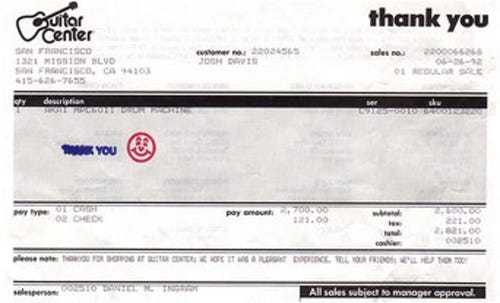
Just imagine if Solid State Logic came out with a MIDI production studio with SSL sound. Their FIRST consumer offering was at $10,000... JUST LIKE AKAI with adjusted inflation.
SO yea.. The sound is different, guys...
It is..
Blame it on James Ting for not paying Roger Linn because he was stealing from Akai Electric Co Ltd...
Buzz Goddard says that "the way parts are laid out on a circuit board is largely what determines a sound" SO James Ting Changed some things about the MPC circuit board layout to prevent paying Roger Linn..ultimately affecting the sound.
The quality of a sound engine doesn’t really determine the quality of the sound, but it’s the software you write. So James Ting changed the software to prevent paying Roger Linn as part of his greater scheme
The New Akai has LITERALLY given us everything except VGA...
I think, when it boils down to it, what Akai has done is give us a fully functional DAW without all the ‘bells and whistles’ that distract from simply making music.
We can get it at a relatively affordable price, with upgrades coming every few months rather than every couple of years.
If it’s possible to create any sound you want inside of a DAW, then it’s possible to do that with the newer MPCs and Akai Force line of products.
Consider it a pad controller connected directly to a DAW that you can add effects to or not, plug up your other synths, sequence workstation and mix and print on..
And they did ALL of that to stay afloat and keep serving this incredibly small niche market.
So don’t blame Akai.
It's not an Akai thing.
It’s a James Ting.
OH yeah, one more ‘Ting ’: let’s talk Roger Linn…
I used to be a big fan of paying Roger Linn what he was worth… However..
Let’s just look at some ‘tings’
1977-
Roger Linn developed his first software for programming drums based on BASIC AND the programming from Intel 8080 and a COMPAL-80, both proprietary languages.
1979-
He developed and released the LM-1
Im not sure what programming architecture Akai used on the subsequent MPC’s, but the MPC’s designed by Roger Linn did NOT have any Windows, Menus, Interfaces or Pointers..
These were things that AKAI (APMI) added to the MPC 2000.. like wavform edit… which totally changed the game and the software..

So if they were still selling his versions of MPC’s in 2004 when Jack O'Donnell acquired the company,
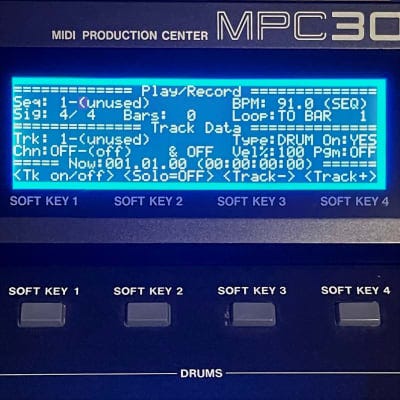
They more than likely were still producing them with the older chips and software. Which was already a strain on the insolvent company he purchased.
And those chips and software were written in a code that was NOT proprietary to Jack O’Donnell….. But were they proprietary to Roger Linn?
Or did he port them over from his previous projects to use while under employment at AKAI?
Those programs are written in BASIC and Intel 8080
So that means, though the programming languages of BASIC and Intel 8080 are proprietary because of their wide usage, they are not able to be copyrighted.
Or else everyone (including Roger Linn) owes
Federico Faggin - Intel 8080
John Ge Kemeny - BASIC
Thomas E. Kurtz - BASIC
A royalty
So I'm sure Roger Linn was fairly compensated for the products that he was contracted to, and like MOST OF US ARTISTS..
Signed a contract that was GREAT at the time and kept him able to work on his ideas but ultimately wasn’t the best business move for him OR AKAI in the future..
And let's be clear that contract was for SOFTWARE (cuz Roland and Maschine and so many others would owe him a check for a 16-square grid right?)
Then he would be able to seek royalty from more than just Akai…


As soon as AKAI added the GUI (Windows, menus, folders, the programming changed. That is what was proprietary..
They own that now.
his imprint lives on in the swing timing..
And unfortunately, he cannot copywrite or be paid a royalty for that..
Perhaps we can encourage Akai AND Roger Linn to satisfy the wants of the fans of their collaboration.
I believe that will get us further than blaming Numark and InMusic for a James Ting…
This article started as a facebook post.. I will update with official references and updated information as time progresses.
Really liked the article, came from a video on the current noise of the "sound of the MPC". I need to point out though, the COMPAL-80 was a computer, not a programming language. I'd call them a boutique computer manufacturer until the IBM PC came into the picture.
Remember, software is the idea which is brought to "life" when you use various programming languages, tools, etc. at your disposal. He doesn't owe Intel, Thomas E. Kurtz or John G. Kemeny royalties, he used the tools at the time to create his own original idea.
I'd have to pull the court/acquisition documents (if they are in the public record) to see what was bought in that mass-sale.