


What's up, MPC Heads! (and lab crew)
This post is inspired by a Facebook post and a short video from Tony Black.

This is a tricky question..
TLDR:
Honestly, i think that adding a bit of sample offset and randominzing that will get you pretty close to what you may get from an older machine. just a small amount will add a bit of fluctuation of when the note hits just by a few samples.. Watch this video with Prince Catty on how Dilla a.) recorded some drums from SSL to tape to the MPC .AND how he edited his drums, with some space in front of the sammple/ and a meticulous ear.
Backstory
When I first started making tracks, I spent a lot of time in Chuck Levin’s music store toying with the MPC5000 and hanging out with some local artists in Woodbridge who were using an MPC2000XL. I promised myself one day I would own an official beat machine, "instead of an institutional edition of Logic Pro 8 I ripped from the Art Institute while I was a student.
Really loving the feel of the MPC I got an MPK49 and started to look for ways I could get that same feel using what I already had..
Logic Pro has a function that lets you take the groove from a MIDI file and use it as a template for other MIDI performances. Luckily, I found a few collections of MIDI files from the more popular MPC series and turned them into groove templates.
One of the things I noticed using the templates was that my tracks sounded more ‘natural,’ which was a good and bad thing. In hindsight, using those templates made my life so much harder.
If I quantized anything with the MPC template, I’d have to forfeit quantization elsewhere, as the timing would feel all over the place. But the tracks still felt natural and human in a unique way.
After a while, I started acting like my softsynths were ‘real’ synthesizers and I began recording them live or resampling directly into Logic. This gave me so much experience in production but was a bit cumbersome as well. (I also was using cracked plugins/DAW with no recall, so I essentially NEEDED to have audio files of all my work.)
I continued to work this way inside of a DAW for years out of necessity, but also because I wanted to get an MPC one day, so why not practice.
But why does any of this matter?
Well in 2012 I got my hands on an MPC1000 and really felt familiar with the timing. It was similar to the 2000XL but completely different from the 5K
No, it wasn’t the same as the Groove templates in the DAW; however, the machine felt familiar.
What makes the MPC’s before the Renaissance so special?
The timing on the MPC was so interesting as it wasn’t perfect. There were small fluctuations in the note timing, even with quantize or Time Correction, that made even simple drum patterns groove in a way.
I’m speculating here, but I think there also is a small delay between when a pad is pressed and a sample plays that adds to the overall ‘punch’ of the MPC. Especially kick drums.
Either way in the simplest way, the timing of these machines really could dictate how you produced on them. You had to be musical or really ‘feel’ the groove or the loop. Night and day to today’s drag-and-drop style of producing.
Besides each model (MPC60, 3k, 2kXL, 4k) every unit had a specific feel to it and and synced with other clocks in different ways. Some swear by the MPC60’s ability to clock with external sources better; others, the MPC3000. Either way, all of that character and jitter was thrown out the window with the introduction of MPC software and the MPC Renaissance.
Let’s Really Look At This ‘Jitter’ Thing
First, here is the video that really inspired me to make this post and drop this gem.
But thats Tony’s analysis. There used to be some jitter tests on the web, im unable to find them however Here is a short video of the MPC3k 'groove' template that i was working with a few years back..
Essentially, this is 1/8th notes quantized to the natural 50% TC setting inside of the MPC3k. In the video, I’m scrolling through MIDI files of notes quantized at 1/8 with swing applied all the way from 50% up to 75%.
Every other note is the ‘swing note,’ so the downbeat note should be relatively still. However, you can see the 'jitter' or randomization of the start points of the MIDI notes on the downbeat.
Roger Linn swing was simply a delay on the 16th note of every 8th note... Basically, the 'and' in counting beats, or the syncopated beat. however..
You can see every downbeat outside of the "1" is a little off, either before or after.. This is because of the jitter.
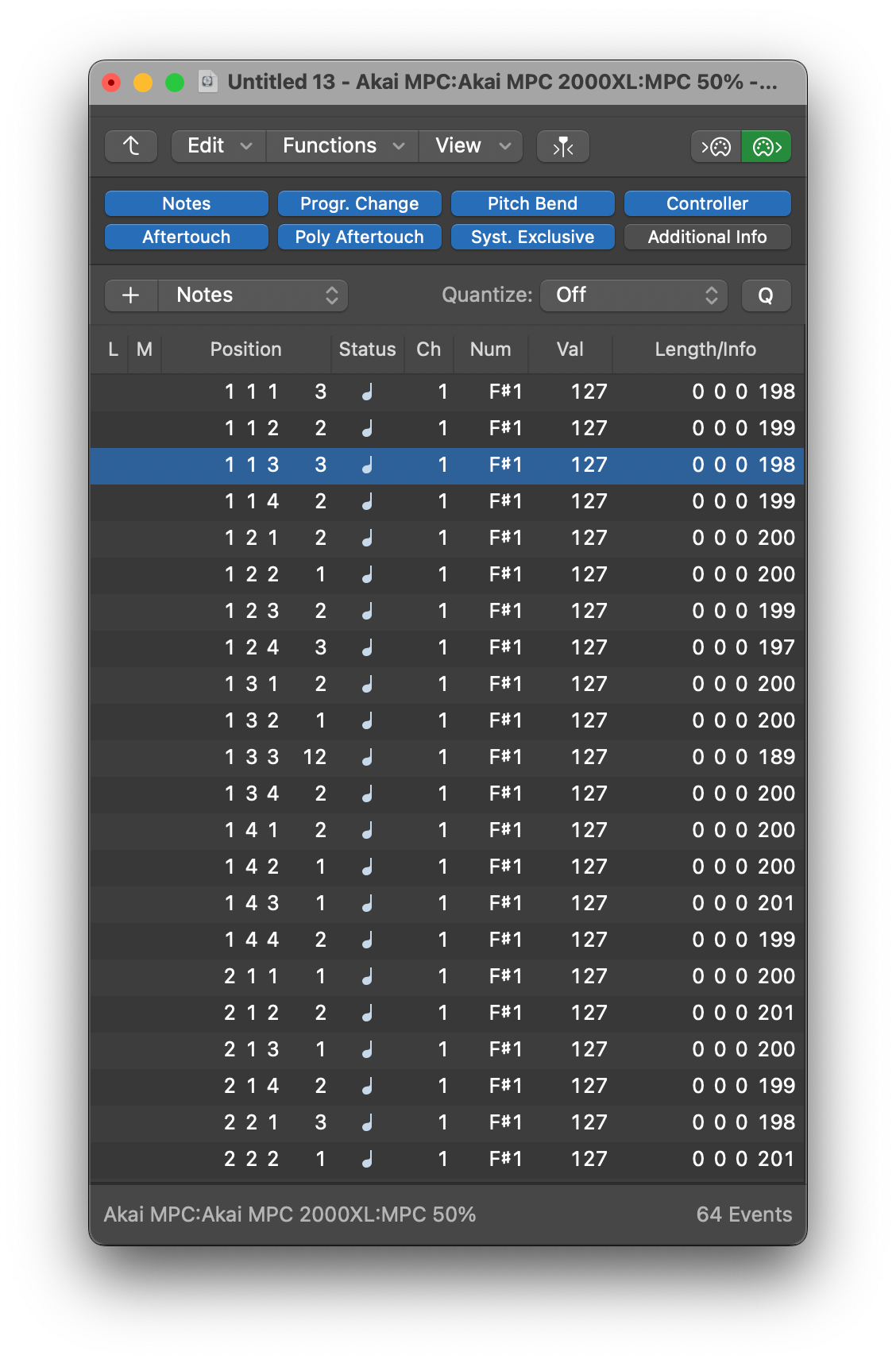
This is what made the machine sound human, even at quantized values. AND on top of this, MPC60 and 3000 were 96PPQN, so there was a bit of quantization happening regardless, just due to hardware restrictions.
96ppqn + jitter = MPC feel... (and punch)
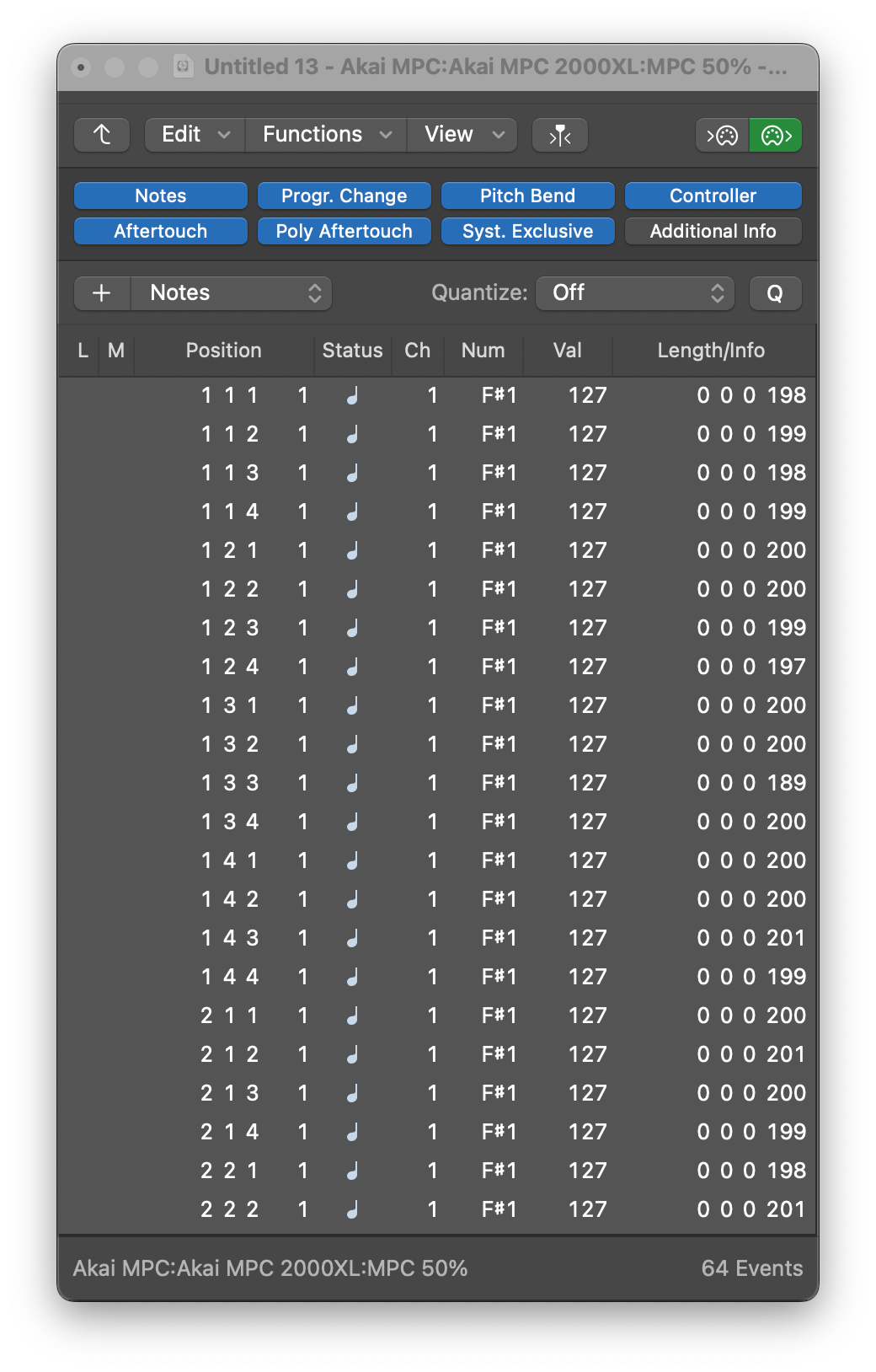
Below is an example of everything quantized to the ‘robotic’ or perfect DAW standard. Every note is exactly where it is ‘supposed’ to be.
Emulating MPC Quantization Jitter/Groove
So if you want to emulate that MPC jitter, which ultimately contributes something to the overall ‘groove’ , then add a bit of offset to your samples.


Randomizing Offset Value
After you add a bit of offset, then randomize the offset for that pad. Shouldn’t be too great a value, but about 0-10 should get the job done. You can slowly tweak this until you hear what you’re looking for.

Hear it for yourself
Demo # 1

Demo #2

Conclusion
For me, this feature bridges the gap between the old and the new. Instead of adding swing or avoiding quantization, you can add the exact amount of timing to each note, especially if you prefer they hit a little late. This lets you import a stale MIDI file and make it feel more human. Without touching any MIDI.
So try these simple techniques to add some vintage MPC feel to your tracks. It’s obviously not the same as a real MPC3k or 60; however, you can use it to sound less robotic without adjusting your MIDI.