


What’s up, Lab Crew,
The community has spoken, and it’s time for AKai to stop just paying attention and start making strategic plays to fully integrate with the blossoming community.
Like artificial intelligence, those who refuse to adapt and fully integrate will be left behind. Survival isn't about the fittest; it's about being most adaptable to change.
The MPC community has shown us the world is changing at breakneck speed (hence the many typos in this article)
So let's get down to the chase
A few moments ago I found myself doing my nighttime routine and clearing my head, when an Idea struck.
It really stemmed from wanting to route my return track on the Akai Force to an external source,
which made me think of a small groove box with some unique features, and a slight comment by an Akai-sponsored creator…
which ultimately led to this idea
Akai has too many creators touching its products for it not to have a sandbox solution.
The MPC Community just dropped damn near a million products overnight,
and in 90% of music creation videos I watch, I can spot an Akai product, controller, groovebox, etc.
But Akai is not leading any charge or behind any new movements in music.
What the actual fuck?
Whilst certain creators have chastised Akai for not going backward in their sound quality by using outdated converter types.
I think Akai should do more to stay ahead of where music is going.
The MPC Sample was a great example of how Akai can quickly deliver a product that satisfies the needs of a growing market.
And with 3d Printing technology and AI coding becoming more accessible to the average person,
it’s time to start thinking about music production where customers are now, and where they are going to be…
And large-format grooveboxes like the MPCXL seem to have less of a cool factor than smaller, portable, modular solutions like the MPC sample.
What is the MPC Sandbox?
The “MPC Sandbox” is a conceptual idea born from multiple products.
If you’re not familiar with Cyberdecks, just take a look at some of these cool builds from around the web.
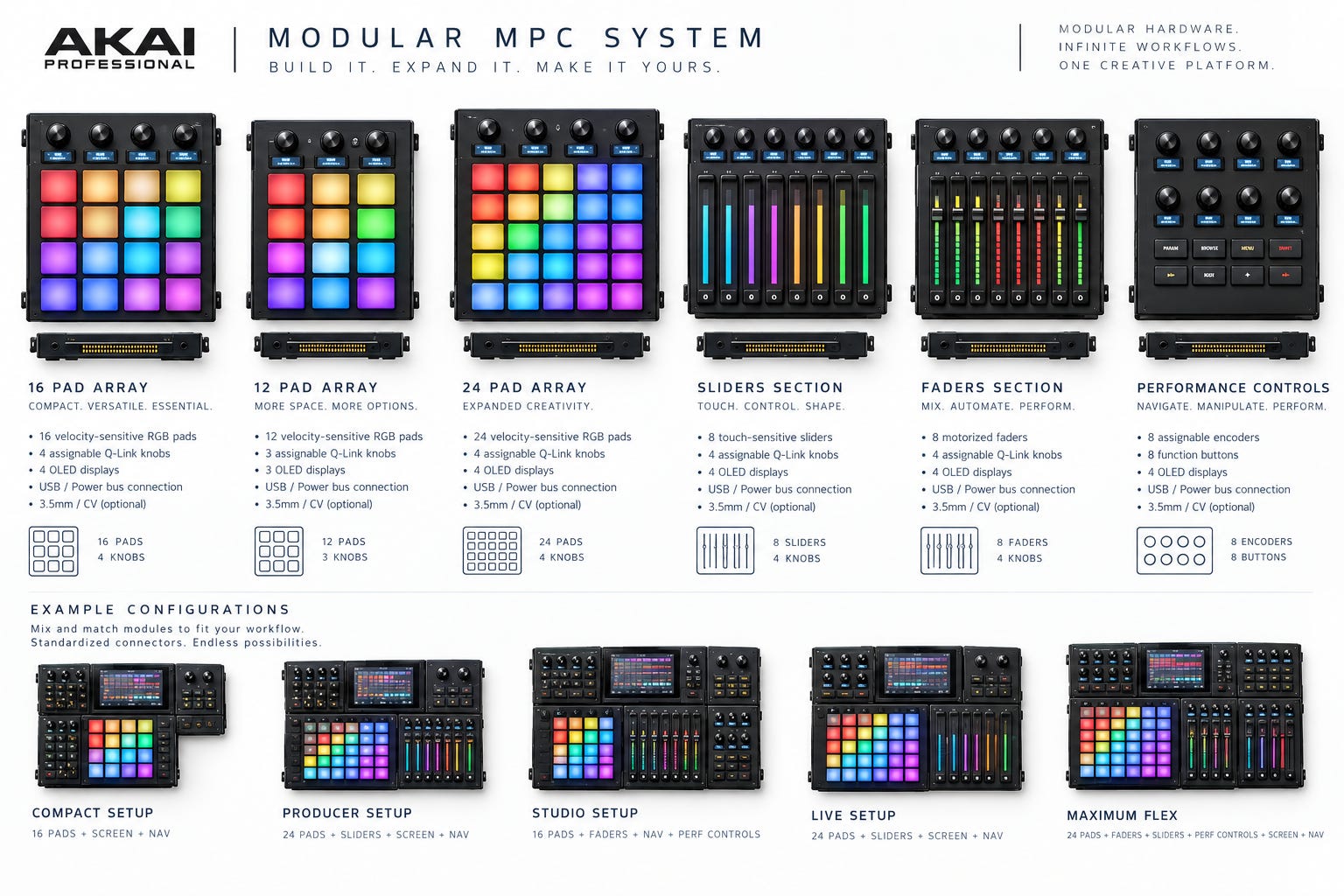
With the current MPC/Akai Force product, every part can be broken down into customizable modules.
Want 16 pads? Or 24 or 64? The pad grid is completely swappable, with accompanying firmware that seamlessly integrates with the main ‘brain’.
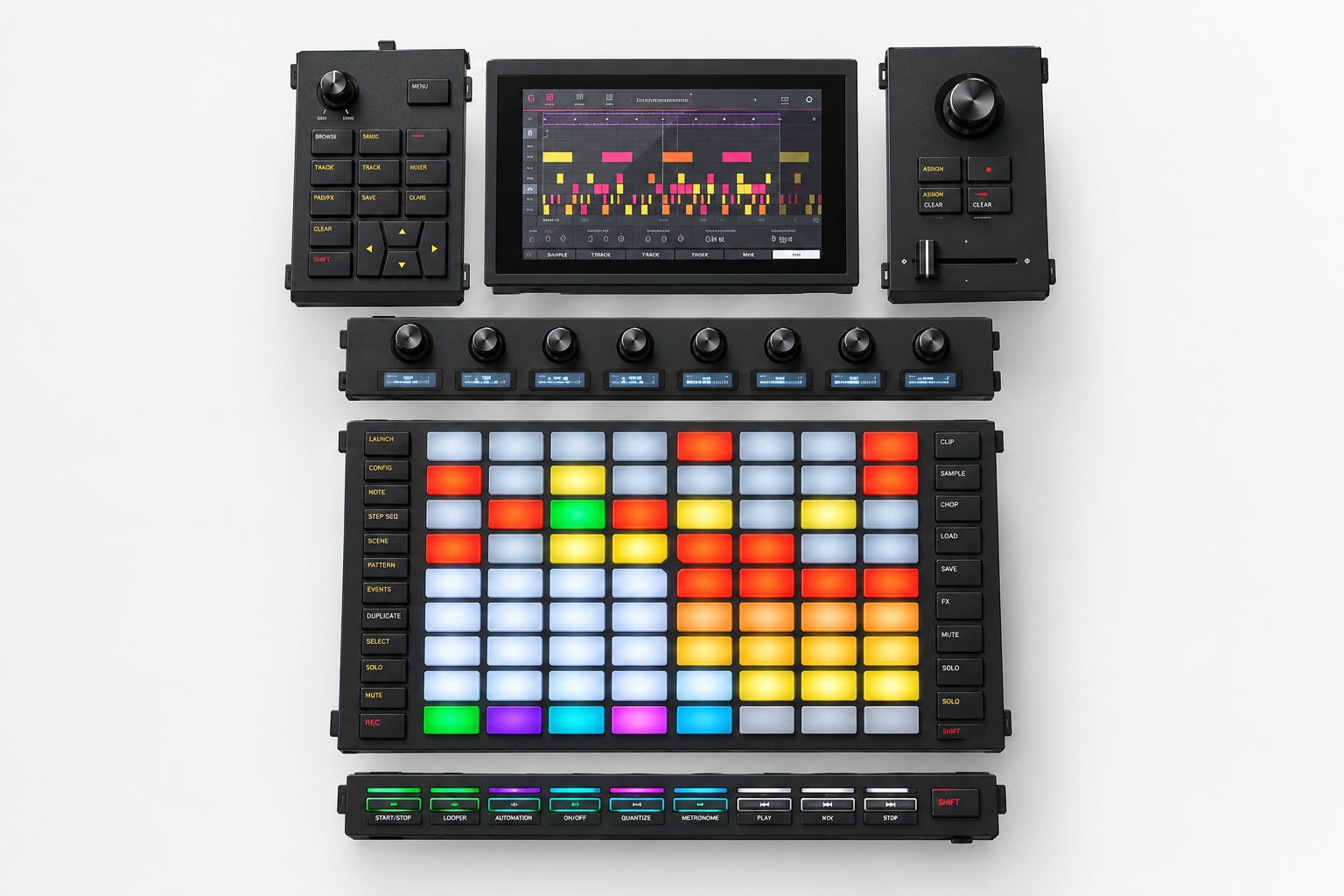
Want sliders? knobs? faders? All of these could be individually purchased (or printed).
Why Modular? And Why Now?
Let’s face it,
the community has built more on JUCE faster than Akai can build on their current format. Though highly compatible, the limitations are slowing progress.
At the time of this article, the Hakai community has over 8K members and is growing, and just the other day, Open500 resurrected a 2007 MPC500 with a different OS, proving to the community that purchases Akai products is always creating.
MPC stands for “music production center,” and that concept can evolve over time.
Akai must start thinking of itself like Nintendo, which has been around for over 100 years.
Nintendo was not reactionary to the market; rather, it responded strategically to the needs of a growing market and played an integral part in shaping gaming culture.
Koji Kondo and Hajime Hirasawa left a lasting impact on the gaming sound to this day.
What impact will Akai and InMusic's current leadership leave?
What impact will the development team leave? Will they acquire everything and dish out romplers until the community ultimately builds its own version of the MPC, like Isla S2400?
OR will AKai foster the creatives, seed the community, and leave a lasting impact on what it means to be a staple in music for generations to come?
Whether they’ve sold enough products or not, September 2026 proves that AKai needs to go back to the drawing board FAST…
and start executing on what the community is demanding before it's too late.
The non-negotiables
SO there have to be some constraints on this shit before it gets out of hand.
The modules have to fit together, and at the end of the day, all compiled, they need to look and feel like an authentic Akai product.
Perhaps something new, but still road-, stage-, and studio-ready, without any hardware hiccups or firmware problems.
That's the challenge for the design team, but it’s an innovative challenge that will help create new marketplace opportunities. The sandbox must always look and feel like a finished product, not just a parts bin.
Users should be able to buy the brain and start making music instantly.
Magnetic, interlocking connections similar to Nintendo Switch controllers would be the strongest solution, though strictly magnetic would read as higher-end... and it just cannot fall apart on stage.
Even if this was a conceptual product presentation, it could signal to the world that AKai is thinking ahead. Steve Jobs would have done it, executed it, and it could have worked immaculately and seamlessly now, with the 17-year plan for the product he really wanted to make.
Two-tiered economic play
A great case study for this would be Prusa,
Josef Prusa from Prague built his business on open-source printers. Everything on GitHub.
Yet they were so locked into their mission that competitors could use their designs to further their own business.
Akai has better positioning than this company.
Rather than competing in the open-source market, they should embrace it, as Ableton has done with Max 4 Live.
The two ecosystems exist hand in hand and essentially feed each other.
What about ownership
That's easy; Akai hosts the marketplace,
sells software on the marketplace, and creatives drive innovation.
Community features that get folded into major releases, gated, licensed with royalties (blockchain can be the origin tracking mechanism)
The major question is: what incentivizes a producer to build inside this ecosystem instead of posting free files on GitHub?
Software base: what is it, and how does it work
The software would have to be open firmware on a dedicated, modular hardware base.
Strict security protocols like Apple would be baseline standards that protect core functions without killing creativity and innovation.
Akai would be leaning on the goodwill of its community developer base, so this would be the strength of a completely separate product line.
Plus, some users want to know that their beat machine isn’t spying on them.
Akai will constantly need to monitor the line between safe and sterile to ensure their limitations aren’t stagnating creativity.
Be friendly and spy on your neighbors.
From the FPV drone community to Bidule, countless companies are quietly servicing small communities at a massive scale.
So what are they getting right? What is Max4Live getting right? What is Teenage Engineering getting right?
What will Akai do differently to serve its current and future markets that overlap with these players?
I argue that Akai/Air has ALL the talent; they may not have the current capital due to their recent acquisitions.
Unfortunately, for a company this old, it’s no longer just about the P&L; it's about brand positioning.