


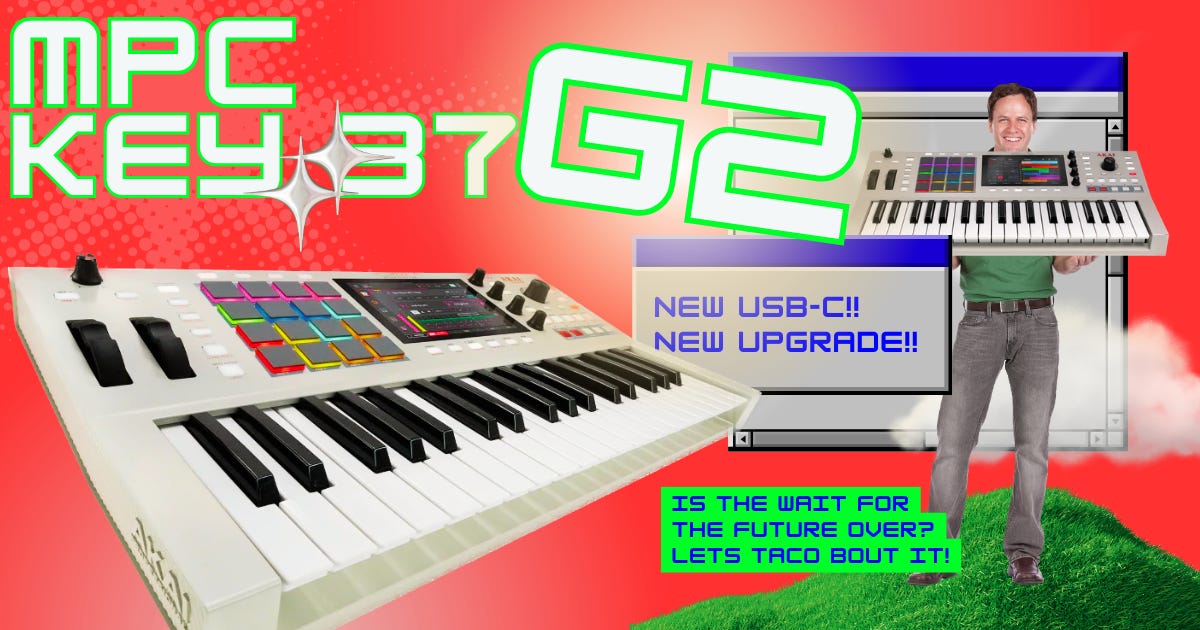
Akai MPC Key 37 G2: The Full Spec Breakdown for Studio Producers
What’s up, fellow technician,
Akai Professional has done it again; today they officially launched the MPC Key 37 G2, their second-generation keyboard sampler, and had me scrambling to figure out what I’ve missed
For those without an MPC, contemplating getting one, OR who are currently running an MPC setup, just know that this isn’t just a cosmetic update. It's a ground-up internal update wrapped in a nostalgic colorway reminiscent of the cream-colored MPCs of the 1980s. Let's dive into a full technical breakdown of what has changed, what is going well, and how this unit fits into the new updates. Let’s dive in.
What is the MPC Key 37 G2?
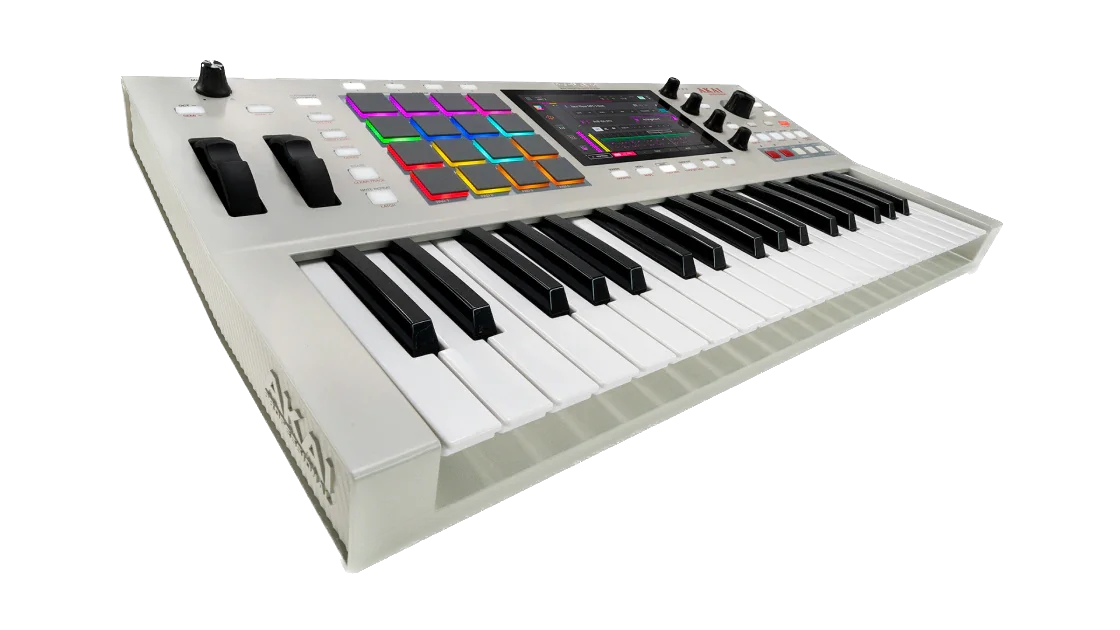
The MPCK Key 37 G2 is a standalone hardware groovebox built in the legacy of the MPC and its predecessor, the MPC Key 37. With semi-weighted ‘synth keys’, sixteen backlit, responsive MPC backlit expressive pads, and a 7-inch display, the goal for this device is to completely replace your DAW. Akai’s new MPC 3.9 OS offers full production capabilities, no computer required, while still functioning as a USB-C audio/MIDI controller and interface when docked into a DAW session.
If you’re looking for a great sketch station you can take from studio to studio, or a DAWless writing rig, a satellite unit for tracking sessions, or whatever you can creatively think of using this for, chances are you’ve found the right device.
Full Tech Specs
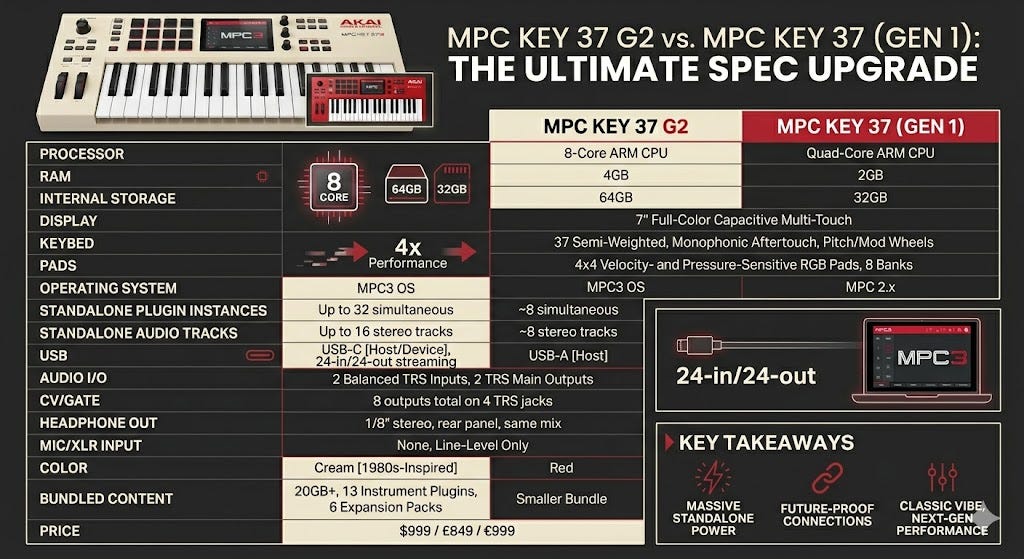
The Processing Upgrade: 8- Core CPU, 4GB RAM, 64 GB Storage
Honestly, this is one of the largest changes affecting performance. The new 8-core processor, the same as the MPC Live III and MPC XL, completely transforms the Key 37 G2 from something that is a ‘capable entry-level sampler’ to a machine that can sustain real production sessions in standalone or DAW mode and still introduce the new user to the MPC line. The official figures from Akai raise the plugin instrument track limit to 32 instances and 16 stereo audio tracks, completely doubling the capabilities.
4GB of RAM directly affects project load time and headroom for sample and plugin-heavy sessions. The increased limit allows you to actually build without waiting or crashing due to memory constraints.
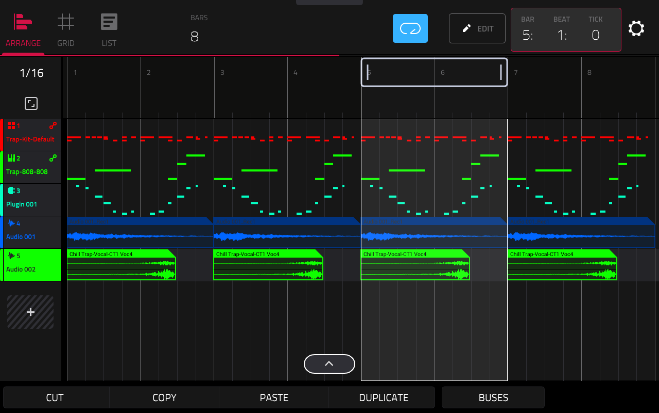
MPC 3.9 OS: Linear Arranger, Built-In Synthesis, DAW Interoperability.
Both the new-generation MPCs ship with MPC 3.9 and the full linear arranger. This feature set has been updated in the MPC Software, so song building, arrangement automation, and clip-to-timeline workflows now also work in Standalone, DAW mode, and Plugin mode. MPC 3.9 also adds a built-in oscillator engine for integrated synthesis. Meaning that on each of your drum pads you now have an oscillator to create synths, effects, 808s, and more.
If this is your primary writing tool, you can now import your stuff into a session more readily and accessibly than before (we’ll go deeper later on)
If you’re getting started with an MPC for the first time, this has everything you need to make music as soon as you turn the unit on.
Keybed and Pads; What a Pro Player Actually Feels

Unchanged from Gen 1, the 37 semi-weighted, dyna-action keys still have monophonic aftertouch, pitch bend, and mod wheel. The keys themselves are roughly 13 cm, which is a little shorter than typical synth keyboards. The white keys are a bit more responsive than the firmer black keys. Honestly, it has a controller-grade ‘feel’ rather than a piano action feel, a light trade-off for a unit built around pad-based production.
Connectivity: Where The Real Upgrade (and Real Limitations) Live
The absolute most consequential change for the MPC line is the move from USB-B to USB-C. At first glance, you may notice the missing USB port; however, the USB-C now supports 24in/24 out streaming and expanded MIDI from host to device.
ok, so before I go further, what does this mean
You can literally plug your MIDI cable into your computer and have audio and MIDI, with your computer acting as the hub. All you have to do is route your audio and MIDI to the appropriate devices in your DAW, and virtually everything you need is handled instantly. No computer mode, just route to USB audio and send audio or MIDI back and forth to your PC.
So if you’re still running 1/4cables OR if you’ve only got a laptop, the expansion capabilities are virtually limitless with this upgrade.
Trust me, this is one of those sleeper updates that you’ll see the advantage when you start to expand.


But What Does It Sound Like?
This is for the subset of people that wonder what the ‘converters’ sound like or if it has the genuine MPC ‘grit’
NO, it doesn’t sound like that, and honestly that sounds bad,
but the MPC itself sounds GREAT.
It's pure, uncompressed digital audio at its finest, enabling you, as a producer, to create with limitless abundance.
Unlike all the other gritty, crunchy, vibey (gear elite fomo) MPCs, the MPC Key 37 G2 Ships with 13 Instrument plugins, like OPX, Jura, Subfactory, alongside six featured expansion packs: Acoustic Tools, Classic Drum Machines, Apollo Retro Kits, Marco Polo Lo-Fi Book, Gemini Future Classic Synths and Orion Future Classic Workstations. All of this content exceeds 20GB.
The Pro pack adds stem separation, real-time stretch and clip matrix for clip-based performances.
So how does it sound? It sounds like you.. Amazing or shite… but it’s all up to you.

Is the MPC Key 37 G2 for Studio Producers or Beginners?
At $999 (*£849 / €999), the MPC Key 37 G2 makes a lot of sense for entry-level producers, engineers, and established creators alike.
For the entry-level or beginner producer, this is a great place to start and put your efforts. Rather than trying to find a MIDI keyboard, instruments, drums, etc, everything you need is right at your fingertips, including a 16-pad drum kit.
When combined with the software, this ecosystem can fully enable anyone as they sit down at the machine.
The upgraddes make it more a satellite production station that is capable of getting effective writing sessions away from the main desk.
Remember, the upgrades are internal, so it's a straightforward ‘yes’ for anyone who’s experienced the limitations of previous iterations.


FAQ
AI Audio Stem Separation:
This is Moises’ flagship capability. It uses artificial intelligence to isolate or completely remove specific parts of an uploaded song—such as separating out the vocals, drums, bass, guitar, or piano into individual tracks (called stems).
Smart Metronome & Click Tracks:
The app automatically analyzes the tempo of an uploaded song and generates an optional, synchronized click track that adapts to any adjustments you make.
AI Chord & Key Detection:
Moises maps out a song’s chord progressions in real-time, displaying synchronized guitar tabs and identifying the master key across 12 different scales.
Audio Pitch & Speed Changer:
You can shift the song’s pitch instantly to match your vocal range or instrument tuning, and slow down or speed up complex parts without distorting the overall pitch.
Song Sections & Looping:
The AI breaks down uploaded tracks into readable sections (like intros, verses, and choruses), allowing you to loop difficult parts over and over for focused practice.
AI Lyric Transcription:
The app can automatically convert the audio of a song into written text, supporting multiple languages like English, Spanish, French, and Portuguese.
Voice & AI Studio:
Advanced tiers allow users to generate synthetic musical stems or model expressive vocals based on real singers to test dynamic harmonies and textures.
Final Verdict
The MPC Key 37 G2 offers meaningful internal upgrades rather than reinventing the wheel. 4x the processing power, double RAM and storage, and USB-C to take the MPC line to the next generation of grooveboxes. Yeah, it’s kind of a no-brainer if you’re already inside of the MPC ecosystem. It’s a great workstation; you’ll upgrade your capabilities with a snappier, smarter version of MPC. Trust this is a meaningful upgrade; it may not look like it, but things are better, and I’m excited to see where AKAI takes this going forward.